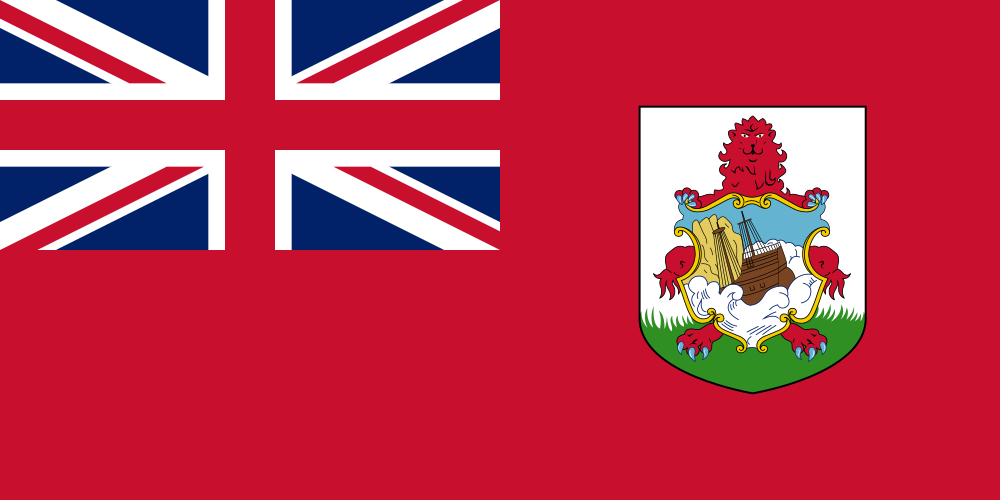
Bermuda advanced its health system by developing a draft national importation policy for medicines and health technologies, supported by technical cooperation from the Pan American Health Organization (PAHO). The policy marks a major step toward strengthening the territory’s regulatory framework by ensuring that procurement and importation processes meet international standards for safety, quality, and affordability.
In response to high rates of illness and death from cardiovascular diseases in Bermuda, during the biennium, the HEARTS model of care for cardiovascular risk management, launched in 2023, was consolidated at the territory’s main public health center. Through this effort, patients received medications free of charge. Targeting the uninsured and underinsured, this initiative aligns with a declaration by the Ministry of Health and Wellness that universal health care must be Bermuda’s vision and mission.
| Outcome Indicator | Baseline/Target | Rating |
|---|---|---|
| 04.c. Number of countries and territories with at least 95% coverage of syphilis treatment in pregnant women | Baseline 2019 | Achieved |
| 04.g. Number of countries and territories reporting at least 95% coverage at the national level of the second dose of measles and rubella containing vaccine (MRCV) | Baseline 2019 | Discrepancy |
| 04.h. Number of countries and territories reporting at least 95% coverage of 3 doses of diphtheria, pertussis, and tetanus -containing vaccine (DPT3) in 80% of municipalities | Baseline 2019 | Not achieved |
| 04.j. Number of countries and territories that have incorporated HPV vaccines in their national vaccination program | Baseline 2019 | Achieved |
| Outcome Indicator | Baseline/Target | Rating |
|---|---|---|
| 08.c. Number of countries that increase the number of units of blood available for transfusion per thousand inhabitants (UBAT) by at least 5% per year to reach the target of 30 UBAT | Baseline 2019 | Achieved |
| 08.f. Number of countries and territories that have implemented institutional frameworks, strategies and/or legal frameworks for the assessment, selection and rational use of medicines and other health technologies including antibiotics | Target 2025 | Achieved |
| 10.a. Number of countries and territories that have increased public expenditure on health to at least 6% of GDP | Target 2025 | Achieved |
| Outcome Indicator | Baseline/Target | Rating |
|---|---|---|
| 21.b. Number of countries and territories that generate, analyze, and use data and information according to health priorities, disaggregated by geopolitical and demographic strata, as appropriate to the national context | Target 2025 | Partially achieved |
| 22.a. Number of countries and territories implementing a funded policy, strategy and/or agenda on research and innovation for health | Target 2025 | Not achieved |
| 22.b. Number of countries and territories that have ethical standards for conducting research with human subjects | Baseline 2019 | Achieved |
| Outcome Indicator | Baseline/Target | Rating |
|---|---|---|
| 23.a. Number of countries and territories that meet or exceed minimum capacities to manage public health risks associated with emergencies | Baseline 2019 | Discrepancy |
| Outcome Indicator | Baseline/Target | Rating |
|---|---|---|
| 27.a. Proportion of countries and territories where the national health authority reports satisfaction with PAHO/WHO’s leading role on global and regional health issues | Target 2025 | Achieved |
| 27.b. Number of countries and territories for which there is alignment between the national health policy, strategy, or plan and the outcomes defined in the PAHO Strategic Plan 2020-2025 | Target 2025 | Achieved |
4. Response capacity for communicable diseases
8. Access to health technologies
10. Increased public health financing
21. Data, information, knowledge, and evidence
22. Research, ethics, and innovation for health
23. Health emergencies preparedness and risk reduction
27. Leadership and governance
| Output (OPT) Indicator | Baseline/Target | Rating |
|---|---|---|
| 02.2.b. Number of countries and territories that measure percentage of pregnant women who received antenatal care four or more times, disaggregated by age, race/ethnicity, and place of residence | Target 2025 | Partially achieved |
| 08.4.c. Number of countries and territories implementing national strategies/mechanisms to improve access, quality, safety, or rational use of blood in their services | Baseline 2023 | Achieved |
| 08.7.a. Number of countries and territories with mechanisms for health technology assessment and evidence-based incorporation, selection, management, and rational use of medicines and other health technologies | Baseline 2023 | Achieved |
| Output (OPT) Indicator | Baseline/Target | Rating |
|---|---|---|
| 05.1.a. Number of countries and territories that are implementing evidence-based national guidelines/protocols/standards for the management of NCDs (i.e. cardiovascular disease, cancer, diabetes, and chronic respiratory disease) | Target 2025 | Partially achieved |
| 05.3.a. Number of countries and territories with comprehensive mental health services integrated into primary health care in at least 50% of primary health care facilities | Baseline 2023 | Partially achieved |
| 05.4.a. Number of countries and territories that collect, analyze, and report a core set of mental health indicators within the national health information systems | Target 2025 | Not achieved |
| 14.1.a. Number of countries and territories that are implementing national policies consistent with the WHO Global Targets 2025 for maternal, infant, and young child nutrition and the nutrition components of the Sustainable Development Goals | Baseline 2023 | Partially achieved |
| Output (OPT) Indicator | Baseline/Target | Rating |
|---|---|---|
| 12.3.a. Number of countries and territories with an established multisectoral coordinating mechanism to oversee national strategies to combat antimicrobial resistance | Baseline 2023 | Achieved |
| Output (OPT) Indicator | Baseline/Target | Rating |
|---|---|---|
| 20.2.a. Number of countries and territories implementing an updated plan of action for strengthening the quality and coverage of vital statistics | Baseline 2023 | Discrepancy |
| Output (OPT) Indicator | Baseline/Target | Rating |
|---|---|---|
| 23.1.b. Number of countries and territories that have evaluated disaster and emergency preparedness capacities in the health sector | Baseline 2023 | Partially achieved |
| 23.2.b. Number of countries and territories with full-time staff assigned to health emergencies | Baseline 2023 | Discrepancy |
| 23.4.a. Number of countries and territories that include safe hospital criteria in the planning, design, construction, and operation of health services | Baseline 2023 | Partially achieved |
| Output (OPT) Indicator | Baseline/Target | Rating |
|---|---|---|
| 27.1.a. Number of countries and territories with a current Country Cooperation Strategy | Baseline 2023 | Achieved |