This page is being updated for the Directing Council version of the end-of-biennium 2024-2025 report. It will also be accessible in Spanish.
Final report on the implementation of the PAHO Strategic Plan 2020–2025
Together with the End-of-Biennium (EOB) report to Governing Bodies (CE178/13), this portal presents the final assessment of PAHO's performance in implementing the Strategic Plan 2020–2025 and Program Budget 2024–2025, documenting the Organization’s results and the contribution of the Pan American Sanitary Bureau (PASB) in supporting Member States.
The last biennium, 2024–2025, occurred in a context shaped by the lingering effects of COVID-19, recurring health emergencies, and structural challenges across the Region. Countries advanced the recovery of essential health services, strengthened health system resilience, and accelerated progress through innovation and targeted interventions.
As PAHO transitions to the next planning cycle, the report highlights progress and remaining gaps, underscoring the need to translate gains into sustained population-level impact while strengthening systems, data, and partnerships.

“I would like to express my sincere gratitude to Member States, to our many partners and contributors, and to PASB personnel for your dedication and trust during this biennium and the entire Strategic Plan period. Together, we have shown that progress is possible even under constraints when purpose is clear and approaches are practical and responsive to country needs.”
The final biennium of SP20–25 took place in a context of ongoing uncertainty, with multiple challenges affecting the achievement of health outcomes. PASB adopted stronger risk management measures focused on protecting results and advancing progress under PB24–25, concentrated on the following areas.
Risk areas managed during 2024–2025
Risk Area | Impact on Results | Key Mitigation Actions | Forward Priorities |
|---|---|---|---|
Financing constraints | Limited flexibility for scale-up and sustainability; constrained country-level impact | Financial stewardship, resource prioritization, partner engagement, national voluntary contributions | Increase flexible and predictable financing; align funding with priorities and high-impact interventions |
Emergency response challenges | Delays in implementation; risks to service continuity and emergency outcomes | Enhanced monitoring, targeted follow-up, project oversight, coordination mechanisms | Strengthen country readiness; increase speed of response operations |
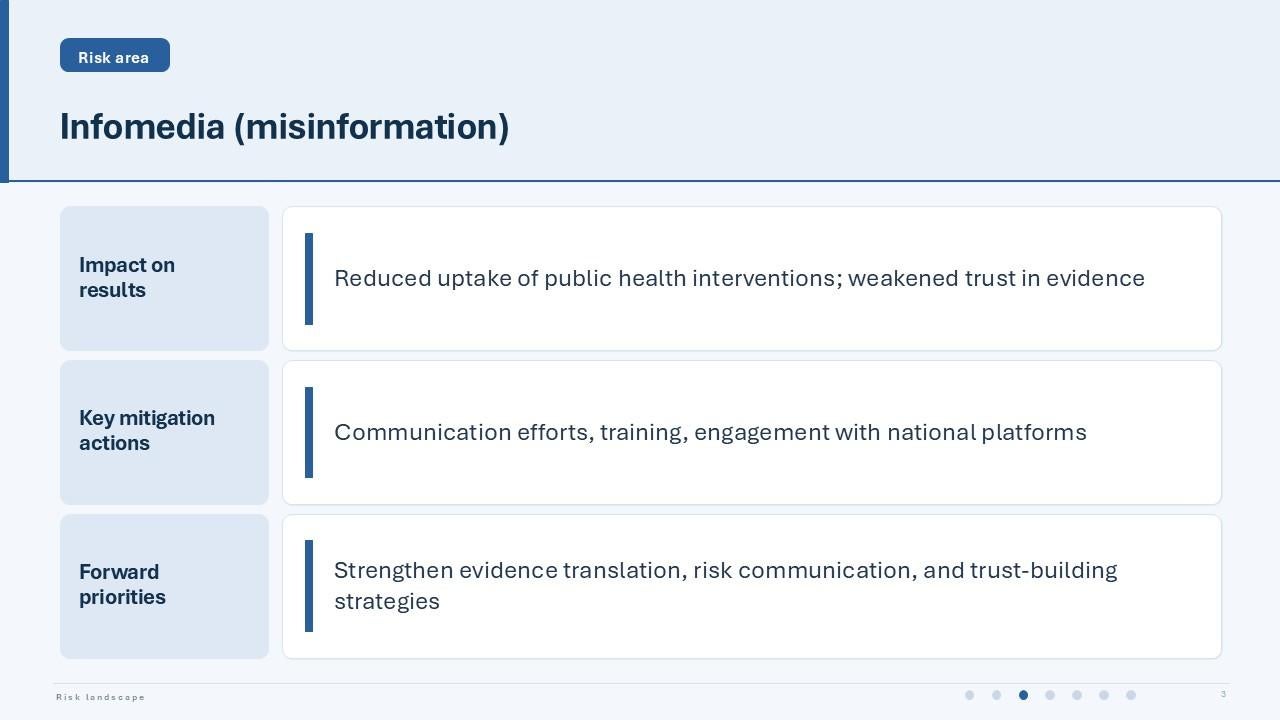
Infomedia (misinformation) | Reduced uptake of public health interventions; weakened trust in evidence | Communication efforts, training, engagement with national platforms | Strengthen evidence translation, risk communication, and trust-building strategies |
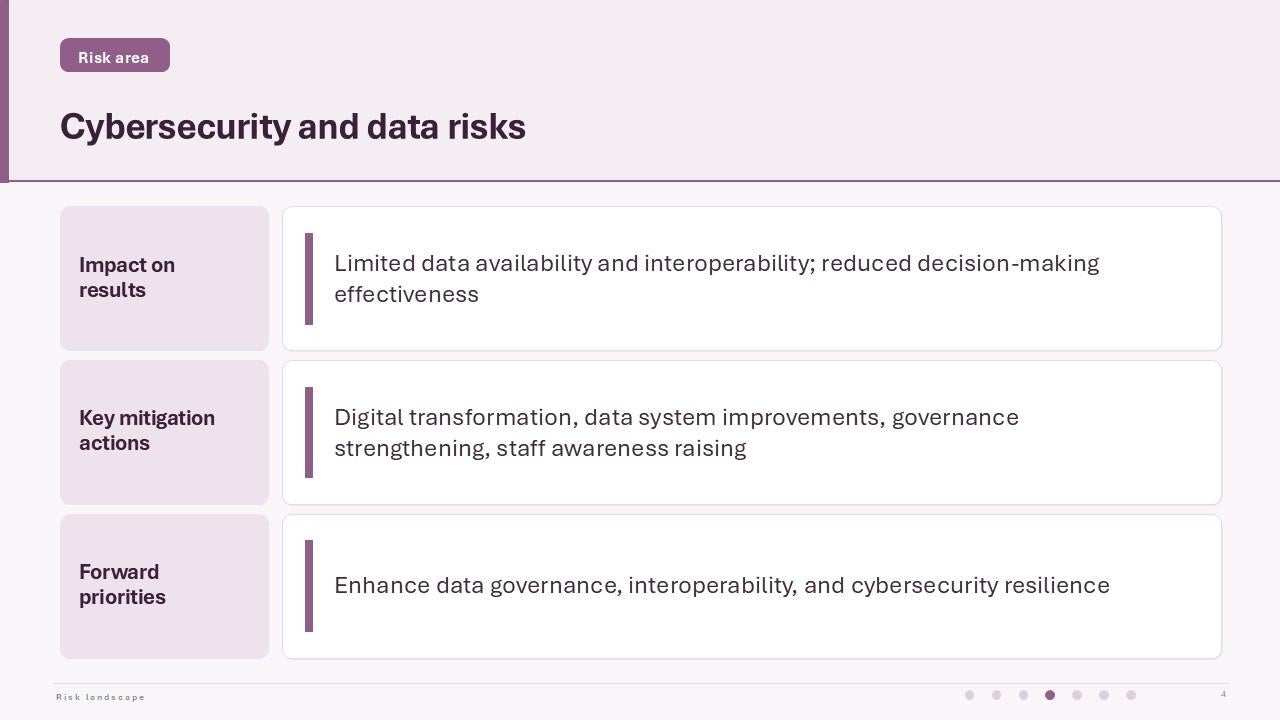
Cybersecurity and data risks | Limited data availability and interoperability; reduced decision-making effectiveness | Digital transformation, data system improvements, governance strengthening, staff awareness raising | Enhance data governance, interoperability, and cybersecurity resilience |
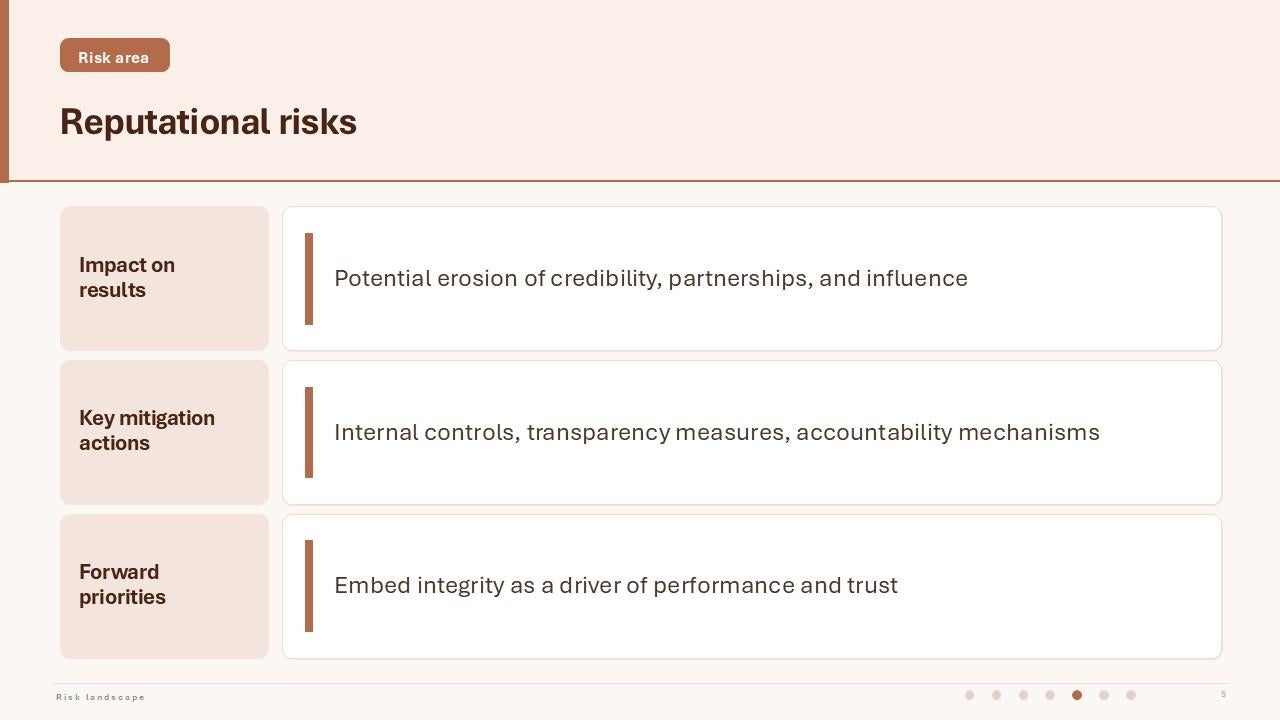
Reputational risks (integrity and trust) | Potential erosion of credibility, partnerships, and influence | Internal controls, transparency measures, accountability mechanisms | Embed integrity as a driver of performance and trust |
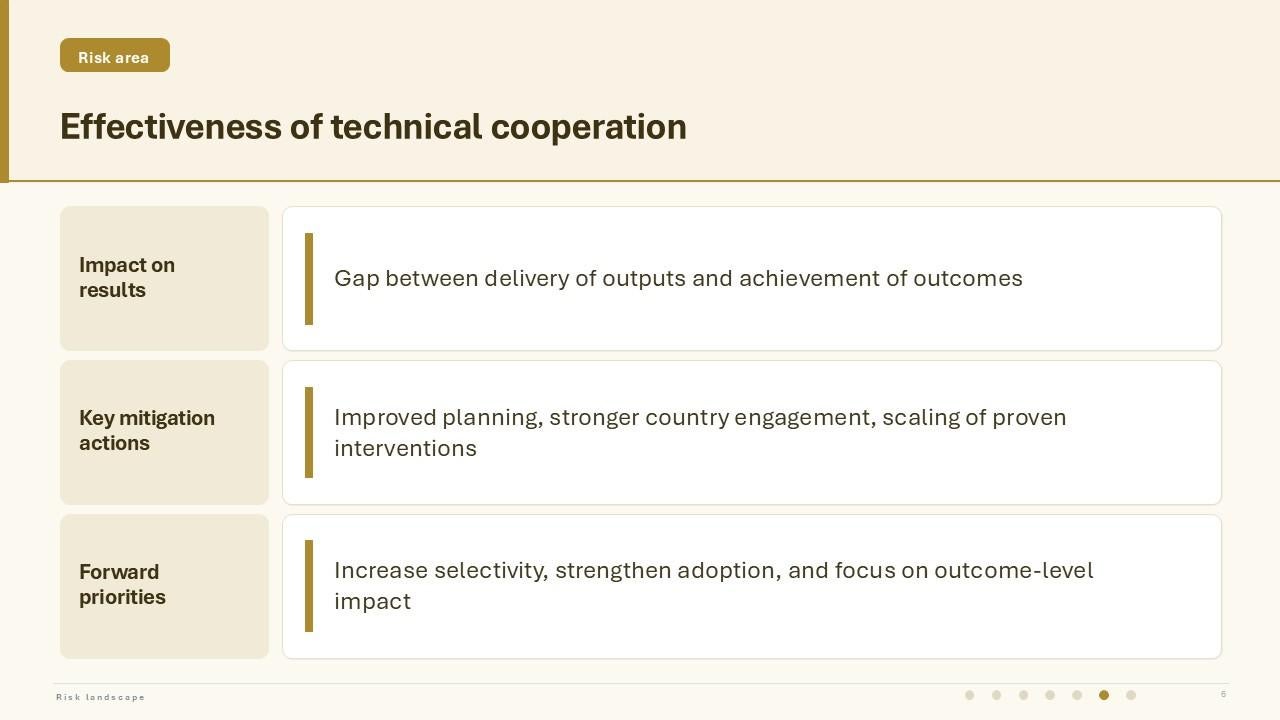
Effectiveness of technical cooperation | Gap between delivery of outputs and achievement of outcomes | Improved planning, stronger country engagement, scaling of proven interventions | Increase selectivity, strengthen adoption, and focus on outcome-level impact |
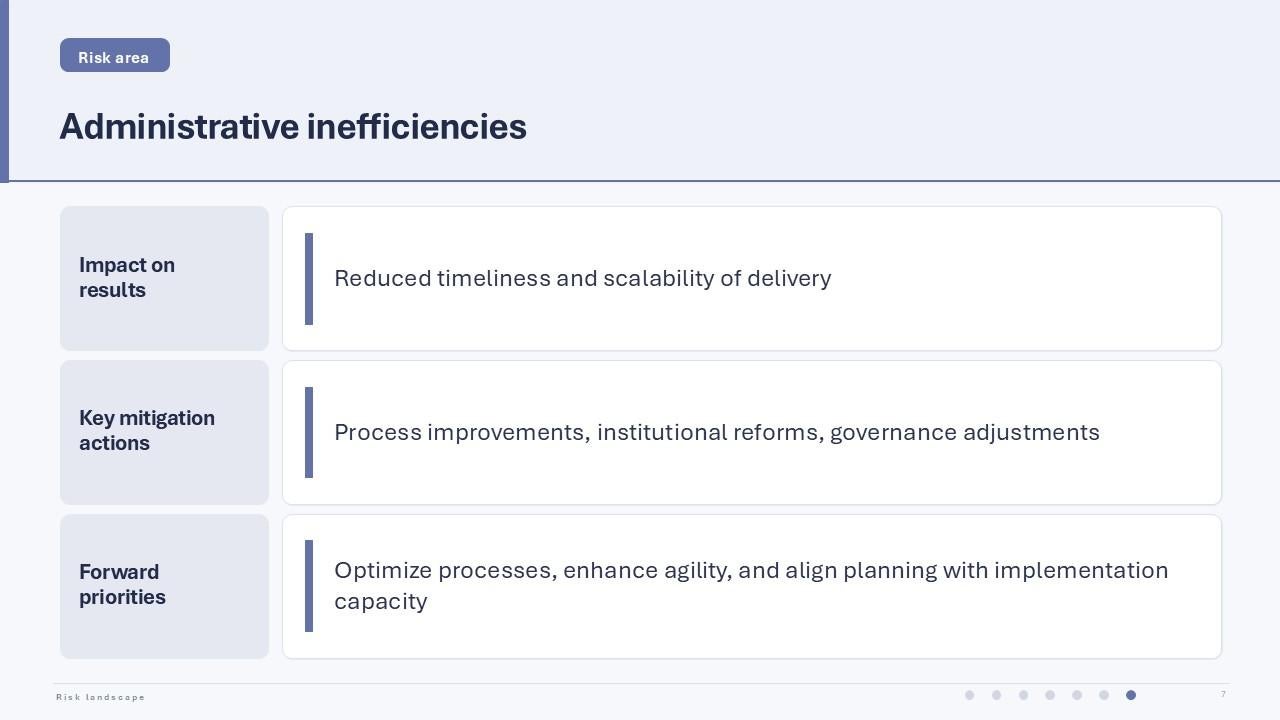
Administrative inefficiencies | Reduced timeliness and scalability of delivery | Process improvements, institutional reforms, governance adjustments | Optimize processes, enhance agility, and align planning with implementation capacity |
Efficiency, transparency, and accountability (ETA) have guided PASB’s implementation of the SP20–25, accelerating with the launch of PAHO Forward in 2023, which institutionalized reforms across core management functions and delivered measurable results in 2024–2025. Concrete examples included:
86% of PAHO Forward Action Plans 1.0 and 2.0 deliverables were completed (131 of 151), embedding ETA across systems and processes as a foundation for sustained modernization. Action Plans 1 and 2 covered the periods from April 2023 to March 2024 and from April 2024 to March 2025.
$7.3 million in savings were achieved between April 2024 and November 2025 through improved cash management and competitive foreign exchange transactions. The Organization is currently implementing Action Plan 3, which covers the period April 2025 to March 2026. Improved liquidity management generated $3.1 million in additional revenue in 2024 through better use of cash balances and diversification through money market funds.
Expanded decentralization and automation, including delegated procurement authority, AI pilots, and digital workflows, and reduced transaction cycles and administrative burdens.
Transparency and oversight were strengthened through the publishing of all corporate external evaluations completed between 2020–2025, as well as a 30% increase in the number of internal audits conducted annually during 2023 to 2025, when compared to 2022. All 28 internal audit reports are available at the request of Member States.
Efficiency gains translate directly into greater technical cooperation and impact, reinforcing trust and accountability while supporting continued improvement and value for money.
Impact results under the SP20–25 were uneven, reflecting persistent system constraints and data limitations, as well as the impact of the COVID-19 pandemic. Progress in policies, capacity, and service delivery often precedes population-level change, highlighting the need for sustained, system-level reforms and a more targeted, pathway-driven framework under the SP26–31.
Progress was strongest where interdependent system components—service delivery, governance, financing, workforce, and information—were aligned through coordinated, interprogrammatic and intersectoral approaches. Overall, results depended on synchronized system change, rather than isolated technical advances.
PHC functions as a structural driver of system performance when health sector reforms align governance, financing, workforce, and service delivery around integrated care, generating gains in access, quality, continuity, and efficiency across health areas. Results also depend on effective territorial implementation, combining national policy with strong local capacity.
Preparedness capacities built during SP20–25 proved critical for COVID-19 response and building resilient health systems but will deliver lasting value only when institutionalized beyond emergencies, underscoring that preparedness is a continuous, cumulative function embedded in health system performance and accountability.
Data and analytics delivered the greatest value when integrated as core health system functions strengthening planning, monitoring, and adaptive decision-making. Sustained investment in data governance, interoperability, and analytical capacity are needed to underpin the Region’s progress toward results.
Partnerships worked best when tied to clear results, aligned with national priorities, and supported over time. Well-managed partnerships can expand PAHO’s influence and financing, an approach fully embraced through the SP26–31.
High levels of output delivery were achieved, but their contribution to outcomes depended on integration into decision making processes, supported by governance, capacity, and feedback mechanisms. Strengthening impact requires outputs to be more explicitly designed around outcomes through clearer theories of change, early engagement, and integration into national systems.
PASB’s ability to support Member States has depended on its own institutional capacities, with resource constraints forcing trade‑offs between speed, depth, and scale despite mitigation through targeted investments that improved responsiveness. Predictable financing, a skilled workforce, modern data systems, and effective governance are essential elements to preserve gains, enhance efficiency, and deliver technical cooperation at the scale needed.
Invest in PHC and integrated health service delivery networks as the organizing platform for improving access, continuity, quality, and efficiency across disease‑specific and population‑based interventions, with explicit attention to territorial implementation capacity.
Accelerate action on NCDs, mental health, elimination of communicable diseases, and health throughout the life course by integrating evidence-based best buys into PHC-based service delivery, supported by sustained financing and performance monitoring.
Maximize the strategic use of regional platforms and public goods, including the RRFs and Virtual Campus for Public Health, to strengthen national capacity, improve efficiency, and support scaling up in priority areas.
Strengthen data, surveillance, and information systems as strategic assets by improving data governance, comparability, interoperability, and use these to support decision‑making, performance monitoring, learning, and timely corrective action.
Scale up multisectoral partnerships to include participation beyond the health sector, including civil society, to address systemic challenges that require integrated policy and implementation responses.
Embed preparedness capacities as a core health systems function by securing sustainable financing, strengthening the health workforce, and institutionalizing legal frameworks.
Develop and apply comprehensive theories of change with clear causal pathways to impact that reflect health system capacities, implementation timelines, and the specific outputs required from PASB to support countries in achieving sustained population-level change.
Strengthen PASB’s internal governance mechanisms and processes to improve interprogrammatic coordination for outcomes that depend on multiple health system functions and programmatic areas.
Strategically leverage PAHO’s partnerships and networks to influence policy, financing, and implementation decisions in countries and accelerate progress toward results at scale.
Reduce reliance on single funding streams and enhance financial resilience and continuity of technical cooperation, including for underfunded programs to further expand partnerships and funding sources.
Strengthen the practice of learning among PASB managers and staff to support adaptive implementation, including the systematic use of evidence and evaluations to refine technical cooperation over time.
Continue to implement new and more efficient ways of working that reinforce PASB’s enabling capacities and enable integrated technical cooperation.