
| Indicator assessment Outcomes | Indicator assessment Outputs | Approved Budget 24-25 US$ M | % Funds Available vs PB | % Implementation funds available |
|
|---|---|---|---|---|---|
| 20. Integrated information systems for health | 18.2 | 67% | 99% | ||
| 18.2 | 67% | 99% | |||
| 18.2 | 67% | 99% | |||
| 18.2 | 67% | 99% | |||
| 18.2 | 67% | 99% | |||
| 18.2 | 67% | 99% | |||
| 18.2 | 67% | 99% | |||
| 18.2 | 67% | 99% | |||
| 18.2 | 67% | 99% | |||
| 18.2 | 67% | 99% | |||
| 18.2 | 67% | 99% | |||
| 18.2 | 67% | 99% | |||
| 18.2 | 67% | 99% | |||
| 18.2 | 67% | 99% | |||
| 21. Data, information, knowledge, and evidence | 16.5 | 106% | 99% | ||
| 16.5 | 106% | 99% | |||
| 16.5 | 106% | 99% | |||
| 16.5 | 106% | 99% | |||
| 16.5 | 106% | 99% | |||
| 16.5 | 106% | 99% | |||
| 16.5 | 106% | 99% | |||
| 16.5 | 106% | 99% | |||
| 16.5 | 106% | 99% | |||
| 16.5 | 106% | 99% | |||
| 16.5 | 106% | 99% | |||
| 16.5 | 106% | 99% | |||
| 16.5 | 106% | 99% | |||
| 16.5 | 106% | 99% | |||
| 16.5 | 106% | 99% | |||
| 16.5 | 106% | 99% | |||
| 16.5 | 106% | 99% | |||
| 16.5 | 106% | 99% | |||
| 16.5 | 106% | 99% | |||
| 16.5 | 106% | 99% | |||
| 16.5 | 106% | 99% | |||
| 16.5 | 106% | 99% | |||
| 16.5 | 106% | 99% | |||
| 16.5 | 106% | 99% | |||
| 16.5 | 106% | 99% | |||
| 16.5 | 106% | 99% | |||
| 22. Research, ethics, and innovation for health | 3.8 | 72% | 99% | ||
| 3.8 | 72% | 99% | |||
| 3.8 | 72% | 99% | |||
| 3.8 | 72% | 99% | |||
| 3.8 | 72% | 99% | |||
| 3.8 | 72% | 99% | |||
| 3.8 | 72% | 99% | |||
| 3.8 | 72% | 99% | |||
| 3.8 | 72% | 99% | |||
| 3.8 | 72% | 99% | |||
| 3.8 | 72% | 99% | |||
| 3.8 | 72% | 99% | |||
| 3.8 | 72% | 99% | |||
| 3.8 | 72% | 99% | |||
| 3.8 | 72% | 99% | |||
| 3.8 | 72% | 99% |
Digital transformation accelerated to expand access to services and strengthen surveillance across the Americas
During the 2024–2025 biennium, digital transformation enabled improved access, service continuity, and public health surveillance. PAHO supported countries in strengthening information systems for health and digital public goods that directly contributed to primary health care (PHC) performance and evidence-based decision-making.
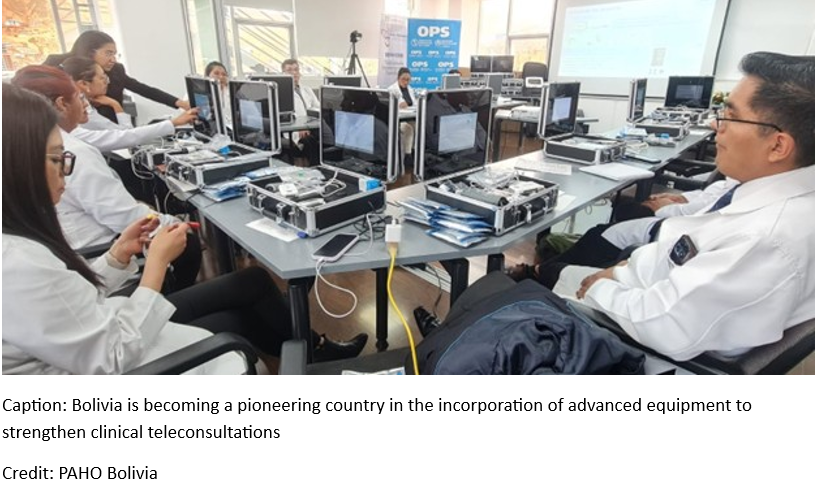
A major focus was the expansion of telehealth as an integrated component of PHC, particularly in rural and hard-to-reach areas. Through regional platforms, equipment deployment, and workforce training, teleconsultations and remote monitoring were scaled up in 22 countries, reducing geographic barriers and improving continuity of care. The deployment of telehealth kits in 14 countries and implementation of the PAHO All-in-One Telehealth Platform in 7 countries strengthened service delivery networks and expanded access to specialist care in remote areas.
 Under the Pan American Highway for Digital Health, PAHO contributed to major advances in cross-border digital interoperability, transforming regional health security infrastructure. Building on systems initially developed for COVID-19 vaccination certification, PAHO supported the implementation of digital yellow fever vaccination certificates aligned with international standards, with Costa Rica and El Salvador becoming the first countries in the world to issue such certificates using globally interoperable specifications. In parallel, PAHO advanced a regional road map for the digital transformation of civil registration and vital statistics systems in the Caribbean, addressing long-standing structural constraints faced by small island developing States.
During the biennium, PAHO strategically strengthened its role as a regional catalyst for large-scale digital health investment by mapping and engaging a rapidly expanding financing landscape. Investments linked to information systems for health exceeded USD 1.4 billion, primarily through loans from the Inter-American Development Bank, the World Bank, and the Development Bank of Latin America and the Caribbean.
By bridging policy, technical standards and financing, PAHO created a new model of cooperation in which digital transformation is not only funded but technically governed and quality-assured. These results strengthen long-term sustainability, support Member States in managing complex digital transformations, and position PAHO as a trusted partner for translating financial resources into integrated, resilient health information systems.
PAHO supported countries in advancing the digital transformation agenda throughout the Region, contributing to achievements such as the following:
Telehealth was scaled in 22 countries through integrated packages of policy guidance, platforms, training, and equipment, thereby strengthening PHC by reducing geographic and socioeconomic barriers to access, improving continuity of services, and supporting regional flagship initiatives. PAHO significantly advanced the digital transformation of PHC by positioning telehealth as a regional digital public good. Central to this effort was the deployment of PAHO’s All‑in‑One Telehealth Platform, implemented in Argentina, Belize, Bolivia (Plurinational State of), Costa Rica, Panama, Suriname, and Trinidad and Tobago.
Under the Pan American Highway for Digital Health, PAHO led a landmark advance in cross‑border digital interoperability. Building on systems developed for COVID‑19 vaccination certification, digital yellow fever certificates aligned with international standards were implemented, with Costa Rica and El Salvador becoming the first countries to issue globally interoperable certificates.
The application of artificial intelligence and cybersecurity advanced from guidance to operational tools, strengthening governance and risk management through regionally deployed readiness assessments, cyber incident response protocols, and digital literacy initiatives that enabled safer and more effective adoption of advanced technologies.
For the first time, Caribbean countries advanced an interagency roadmap for the digital transformation of civil registration and vital statistics, thanks to collaboration from PAHO and Bloomberg Philanthropies. Other advances were made at country level: for example, Belize laid the foundation for an integrated and interoperable national health data ecosystem through multisectoral mapping of health data and adoption of the eleventh revision of the International Classification of Diseases (ICD 11) as a national standard. Similarly, Chile strengthened digital interoperability by adopting ICD‑11, DHIS2, and Go. Data to improve data integration for clinical management and public‑health surveillance.
During the biennium, investments linked to information systems exceeded $1.4 billion, primarily through loans from the IDB, the World Bank, and the Development Bank of Latin America and the Caribbean (CAF), strengthening the sustainability and coherence of national digital health investments. PAHO strengthened its role as a regional catalyst for large‑scale digital health investment by mapping and engaging the rapidly expanding financing landscape for information systems for health.
Challenges affecting implementation, scale, and sustainability remain, such as the following:
While there have been many advances related to digital transformation, this has not yet consistently translated into system‑wide change, with many results remaining at project level and fragile long‑term financing concerns in several countries.
Fragmented data governance and interoperability persist across countries.
The Bureau worked with countries to strengthen the evidence ecosystem, contributing to achievements such as the following:
Geospatial intelligence tools supported health system planning in several countries, helping to prioritize investments based on gaps identified through integrated geospatial data on population distribution, service availability, and access barriers with epidemiological and vulnerability indicators. This included the creation of the Geospatial Opportunity Index, based on a harmonized master list of nearly 600 000 health facilities, that was developed by PAHO and the IDB enables optimization of PHC.
The measurement of health gaps was enabled through the region‑wide rollout of the Health Inequalities Quantifier Tool, co-designed with Peru. The tool standardizes and automates the calculation of health disparity metrics using country data, reducing knowledge barriers and supporting routine monitoring to inform targeted planning.
A new regional horizon scanning platform was developed to strengthen science intelligence capacities, enabling identification of emerging technologies and trends that are relevant to public health priorities. The platform integrates analyses of research, clinical trials, and regulatory signals, transforming fragmented information into actionable intelligence.
The PAHO Institutional Repository for Information Sharing (IRIS) was modernized to enhance performance, cybersecurity, and discoverability, sustaining high regional use.
Access to evidence-informed recommendations for policy and practice was expanded through platforms such as BIGG‑REC, which consolidated over 4,000 of regional and global evidence‑based recommendations in multiple languages, 600 of which were added or revised in 2025.
The challenges slowing the translation of evidence into sustained outcomes included:
Expanded access to data and evidence did not consistently translate into uptake and use for decision‑making.
Limited availability of specialized staff and computational infrastructure constrained the scaling of high‑demand evidence and health intelligence initiatives.
Rapid growth in demand for data, knowledge, and analytical support outpaced existing coordination mechanisms and staffing, affecting the timeliness and consistency of responses.
The Bureau's leadership and technical cooperation reinforced a supportive environment for science, research, ethics, and innovation, contributing to achievements such as the following.
Twenty-two research regulations were developed for 12 Member States, strengthening alignment with international ethical and regulatory standards. In Paraguay, for example, a policy on ethics in health research and updated clinical trial regulations were adopted, supported by technical cooperation, leading to significant improvements in indicators for research ethics systems.
In support of these research governance advances, a tool for the accreditation of ethics committees and a regional template for clinical trial agreements were developed, and ethics review capacity was reinforced through increased training.
Fifteen countries were implementing a funded policy, strategy, and/or agenda on research and innovation for health, five more than in 2019. As an example of country-level progress, the Plurinational State of Bolivia strengthened its health research system by defining research priorities and enhancing health sector coordination with academia, with the aim of increasing the production of scientific evidence for health decision-making.
As part of a regional Clinical Trial Accelerator initiative to strengthen collaboration and efficiency in clinical research, PAHO launched the Portal of Clinical Trials of the Americas and improved horizon-scanning capacity. Health technologies, research trends and early innovation signals can now be systematically identified with a PASB-developed tool for the large-scale analysis of scientific publications and ongoing research activity. PASB developed tools supported by artificial intelligence (AI) to analyze over 1.1 million clinical trial registration entries during 2025.
Challenges affecting sustainability and scale include the following:
While significant progress was achieved in advancing adherence to international ethical regulatory standards through research ethics and clinical trial regulatory frameworks, the advances have often outpaced institutional capacities to implement these standards in a sustainable manner.
Insufficient resources and infrastructure constrain the scaling and long-term sustainability of research and innovation initiatives, including advanced analytics and clinical trials intelligence that are part of the Clinical Trial Accelerator initiative.
* Countries and territories that did not complete the assessment or for which there was no consensus on the assessment results are not reflected in the final ratings for the indicator.