| Indicator assessment Outcomes | Indicator assessment Outputs | Approved Budget 24-25 US$ M | % Funds Available vs PB | % Implementation funds available |
|
|---|---|---|---|---|---|
| 1. Access to comprehensive and quality health services | 29.0 | 72% | 99% | ||
| 29.0 | 72% | 99% | |||
| 29.0 | 72% | 99% | |||
| 29.0 | 72% | 99% | |||
| 29.0 | 72% | 99% | |||
| 29.0 | 72% | 99% | |||
| 29.0 | 72% | 99% | |||
| 29.0 | 72% | 99% | |||
| 29.0 | 72% | 99% | |||
| 29.0 | 72% | 99% | |||
| 29.0 | 72% | 99% | |||
| 29.0 | 72% | 99% | |||
| 2. Health throughout the life course | 35.0 | 57% | 93% | ||
| 35.0 | 57% | 93% | |||
| 35.0 | 57% | 93% | |||
| 35.0 | 57% | 93% | |||
| 35.0 | 57% | 93% | |||
| 35.0 | 57% | 93% | |||
| 35.0 | 57% | 93% | |||
| 35.0 | 57% | 93% | |||
| 35.0 | 57% | 93% | |||
| 35.0 | 57% | 93% | |||
| 35.0 | 57% | 93% | |||
| 35.0 | 57% | 93% | |||
| 35.0 | 57% | 93% | |||
| 35.0 | 57% | 93% | |||
| 35.0 | 57% | 93% | |||
| 35.0 | 57% | 93% | |||
| 35.0 | 57% | 93% | |||
| 35.0 | 57% | 93% | |||
| 35.0 | 57% | 93% | |||
| 35.0 | 57% | 93% | |||
| 35.0 | 57% | 93% | |||
| 35.0 | 57% | 93% | |||
| 35.0 | 57% | 93% | |||
| 35.0 | 57% | 93% | |||
| 35.0 | 57% | 93% | |||
| 35.0 | 57% | 93% | |||
| 35.0 | 57% | 93% | |||
| 35.0 | 57% | 93% | |||
| 35.0 | 57% | 93% | |||
| 35.0 | 57% | 93% | |||
| 35.0 | 57% | 93% | |||
| 35.0 | 57% | 93% | |||
| 35.0 | 57% | 93% | |||
| 35.0 | 57% | 93% | |||
| 35.0 | 57% | 93% | |||
| 35.0 | 57% | 93% | |||
| 35.0 | 57% | 93% | |||
| 35.0 | 57% | 93% | |||
| 35.0 | 57% | 93% | |||
| 35.0 | 57% | 93% | |||
| 35.0 | 57% | 93% | |||
| 35.0 | 57% | 93% | |||
| 35.0 | 57% | 93% | |||
| 35.0 | 57% | 93% | |||
| 35.0 | 57% | 93% | |||
| 35.0 | 57% | 93% | |||
| 35.0 | 57% | 93% | |||
| 35.0 | 57% | 93% | |||
| 3. Quality care for older people | 4.0 | 62% | 100% | ||
| 4.0 | 62% | 100% | |||
| 4.0 | 62% | 100% | |||
| 4.0 | 62% | 100% | |||
| 4.0 | 62% | 100% | |||
| 4.0 | 62% | 100% | |||
| 4.0 | 62% | 100% | |||
| 4.0 | 62% | 100% | |||
| 4.0 | 62% | 100% | |||
| 4.0 | 62% | 100% | |||
| 4.0 | 62% | 100% | |||
| 4.0 | 62% | 100% | |||
| 4.0 | 62% | 100% | |||
| 4.0 | 62% | 100% | |||
| 4.0 | 62% | 100% | |||
| 4.0 | 62% | 100% | |||
| 4.0 | 62% | 100% | |||
| 4.0 | 62% | 100% | |||
| 4.0 | 62% | 100% | |||
| 4.0 | 62% | 100% | |||
| 4.0 | 62% | 100% | |||
| 4.0 | 62% | 100% | |||
| 4.0 | 62% | 100% | |||
| 4.0 | 62% | 100% | |||
| 4.0 | 62% | 100% | |||
| 4.0 | 62% | 100% | |||
| 4.0 | 62% | 100% | |||
| 4.0 | 62% | 100% | |||
| 4.0 | 62% | 100% | |||
| 4.0 | 62% | 100% | |||
| 4.0 | 62% | 100% | |||
| 4.0 | 62% | 100% | |||
| 4.0 | 62% | 100% | |||
| 4.0 | 62% | 100% | |||
| 4.0 | 62% | 100% | |||
| 4.0 | 62% | 100% | |||
| 4.0 | 62% | 100% | |||
| 4.0 | 62% | 100% | |||
| 7. Health workforce | 14.0 | 99% | 91% | ||
| 14.0 | 99% | 91% | |||
| 14.0 | 99% | 91% | |||
| 14.0 | 99% | 91% | |||
| 14.0 | 99% | 91% | |||
| 14.0 | 99% | 91% | |||
| 14.0 | 99% | 91% | |||
| 14.0 | 99% | 91% | |||
| 14.0 | 99% | 91% | |||
| 14.0 | 99% | 91% | |||
| 14.0 | 99% | 91% | |||
| 14.0 | 99% | 91% | |||
| 14.0 | 99% | 91% | |||
| 14.0 | 99% | 91% | |||
| 14.0 | 99% | 91% | |||
| 14.0 | 99% | 91% | |||
| 8. Access to health technologies | 41.5 | 133% | 85% | ||
| 41.5 | 133% | 85% | |||
| 41.5 | 133% | 85% | |||
| 41.5 | 133% | 85% | |||
| 41.5 | 133% | 85% | |||
| 41.5 | 133% | 85% | |||
| 41.5 | 133% | 85% | |||
| 41.5 | 133% | 85% | |||
| 41.5 | 133% | 85% | |||
| 41.5 | 133% | 85% | |||
| 41.5 | 133% | 85% | |||
| 41.5 | 133% | 85% | |||
| 41.5 | 133% | 85% | |||
| 41.5 | 133% | 85% | |||
| 41.5 | 133% | 85% | |||
| 41.5 | 133% | 85% | |||
| 41.5 | 133% | 85% | |||
| 41.5 | 133% | 85% | |||
| 41.5 | 133% | 85% | |||
| 41.5 | 133% | 85% | |||
| 41.5 | 133% | 85% | |||
| 41.5 | 133% | 85% | |||
| 41.5 | 133% | 85% | |||
| 41.5 | 133% | 85% | |||
| 41.5 | 133% | 85% | |||
| 41.5 | 133% | 85% | |||
| 41.5 | 133% | 85% | |||
| 41.5 | 133% | 85% | |||
| 41.5 | 133% | 85% | |||
| 41.5 | 133% | 85% | |||
| 41.5 | 133% | 85% | |||
| 41.5 | 133% | 85% | |||
| 41.5 | 133% | 85% | |||
| 41.5 | 133% | 85% | |||
| 41.5 | 133% | 85% | |||
| 41.5 | 133% | 85% | |||
| 41.5 | 133% | 85% | |||
| 41.5 | 133% | 85% | |||
| 41.5 | 133% | 85% | |||
| 41.5 | 133% | 85% | |||
| 41.5 | 133% | 85% | |||
| 41.5 | 133% | 85% | |||
| 41.5 | 133% | 85% | |||
| 41.5 | 133% | 85% | |||
| 41.5 | 133% | 85% | |||
| 41.5 | 133% | 85% | |||
| 41.5 | 133% | 85% | |||
| 41.5 | 133% | 85% | |||
| 41.5 | 133% | 85% | |||
| 41.5 | 133% | 85% | |||
| 41.5 | 133% | 85% | |||
| 41.5 | 133% | 85% | |||
| 41.5 | 133% | 85% | |||
| 41.5 | 133% | 85% | |||
| 41.5 | 133% | 85% | |||
| 41.5 | 133% | 85% | |||
| 41.5 | 133% | 85% | |||
| 41.5 | 133% | 85% | |||
| 41.5 | 133% | 85% | |||
| 41.5 | 133% | 85% | |||
| 9. Strengthened stewardship and governance | 10.9 | 59% | 98% | ||
| 10.9 | 59% | 98% | |||
| 10.9 | 59% | 98% | |||
| 10.9 | 59% | 98% | |||
| 10.9 | 59% | 98% | |||
| 10.9 | 59% | 98% | |||
| 10.9 | 59% | 98% | |||
| 10.9 | 59% | 98% | |||
| 10.9 | 59% | 98% | |||
| 10.9 | 59% | 98% | |||
| 10.9 | 59% | 98% | |||
| 10.9 | 59% | 98% | |||
| 10.9 | 59% | 98% | |||
| 10.9 | 59% | 98% | |||
| 10.9 | 59% | 98% | |||
| 10.9 | 59% | 98% | |||
| 10.9 | 59% | 98% | |||
| 10.9 | 59% | 98% | |||
| 10.9 | 59% | 98% | |||
| 10.9 | 59% | 98% | |||
| 10.9 | 59% | 98% | |||
| 10.9 | 59% | 98% | |||
| 10.9 | 59% | 98% | |||
| 10.9 | 59% | 98% | |||
| 10.9 | 59% | 98% | |||
| 10.9 | 59% | 98% | |||
| 10.9 | 59% | 98% | |||
| 10.9 | 59% | 98% | |||
| 10.9 | 59% | 98% | |||
| 10.9 | 59% | 98% | |||
| 10.9 | 59% | 98% | |||
| 10.9 | 59% | 98% | |||
| 10.9 | 59% | 98% | |||
| 10.9 | 59% | 98% | |||
| 10.9 | 59% | 98% | |||
| 10.9 | 59% | 98% | |||
| 10. Increased public health financing | 5.8 | 33% | 101% | ||
| 5.8 | 33% | 101% | |||
| 5.8 | 33% | 101% | |||
| 5.8 | 33% | 101% | |||
| 5.8 | 33% | 101% | |||
| 5.8 | 33% | 101% | |||
| 5.8 | 33% | 101% | |||
| 5.8 | 33% | 101% | |||
| 5.8 | 33% | 101% | |||
| 5.8 | 33% | 101% | |||
| 5.8 | 33% | 101% | |||
| 5.8 | 33% | 101% | |||
| 5.8 | 33% | 101% | |||
| 5.8 | 33% | 101% | |||
| 5.8 | 33% | 101% | |||
| 5.8 | 33% | 101% | |||
| 5.8 | 33% | 101% | |||
| 5.8 | 33% | 101% | |||
| 5.8 | 33% | 101% | |||
| 5.8 | 33% | 101% | |||
| 5.8 | 33% | 101% | |||
| 5.8 | 33% | 101% | |||
| 5.8 | 33% | 101% | |||
| 5.8 | 33% | 101% | |||
| 5.8 | 33% | 101% | |||
| 5.8 | 33% | 101% | |||
| 5.8 | 33% | 101% | |||
| 5.8 | 33% | 101% | |||
| 5.8 | 33% | 101% | |||
| 5.8 | 33% | 101% | |||
| 5.8 | 33% | 101% | |||
| 5.8 | 33% | 101% | |||
| 5.8 | 33% | 101% | |||
| 5.8 | 33% | 101% | |||
| 5.8 | 33% | 101% | |||
| 5.8 | 33% | 101% | |||
| 11. Strengthened financial protection | 4.1 | 41% | 100% | ||
| 4.1 | 41% | 100% | |||
| 4.1 | 41% | 100% | |||
| 4.1 | 41% | 100% | |||
| 4.1 | 41% | 100% | |||
| 4.1 | 41% | 100% | |||
| 4.1 | 41% | 100% | |||
| 4.1 | 41% | 100% | |||
| 4.1 | 41% | 100% | |||
| 4.1 | 41% | 100% | |||
| 4.1 | 41% | 100% | |||
| 4.1 | 41% | 100% | |||
| 4.1 | 41% | 100% | |||
| 4.1 | 41% | 100% | |||
| 4.1 | 41% | 100% | |||
| 4.1 | 41% | 100% | |||
| 4.1 | 41% | 100% | |||
| 4.1 | 41% | 100% | |||
| 4.1 | 41% | 100% | |||
| 4.1 | 41% | 100% | |||
| 4.1 | 41% | 100% | |||
| 4.1 | 41% | 100% | |||
| 4.1 | 41% | 100% | |||
| 4.1 | 41% | 100% | |||
| 4.1 | 41% | 100% | |||
| 4.1 | 41% | 100% | |||
| 4.1 | 41% | 100% | |||
| 4.1 | 41% | 100% | |||
| 4.1 | 41% | 100% | |||
| 4.1 | 41% | 100% | |||
| 4.1 | 41% | 100% | |||
| 4.1 | 41% | 100% | |||
| 4.1 | 41% | 100% | |||
| 4.1 | 41% | 100% | |||
| 4.1 | 41% | 100% | |||
| 4.1 | 41% | 100% |
Primary health care strengthened as the foundation of health system transformation
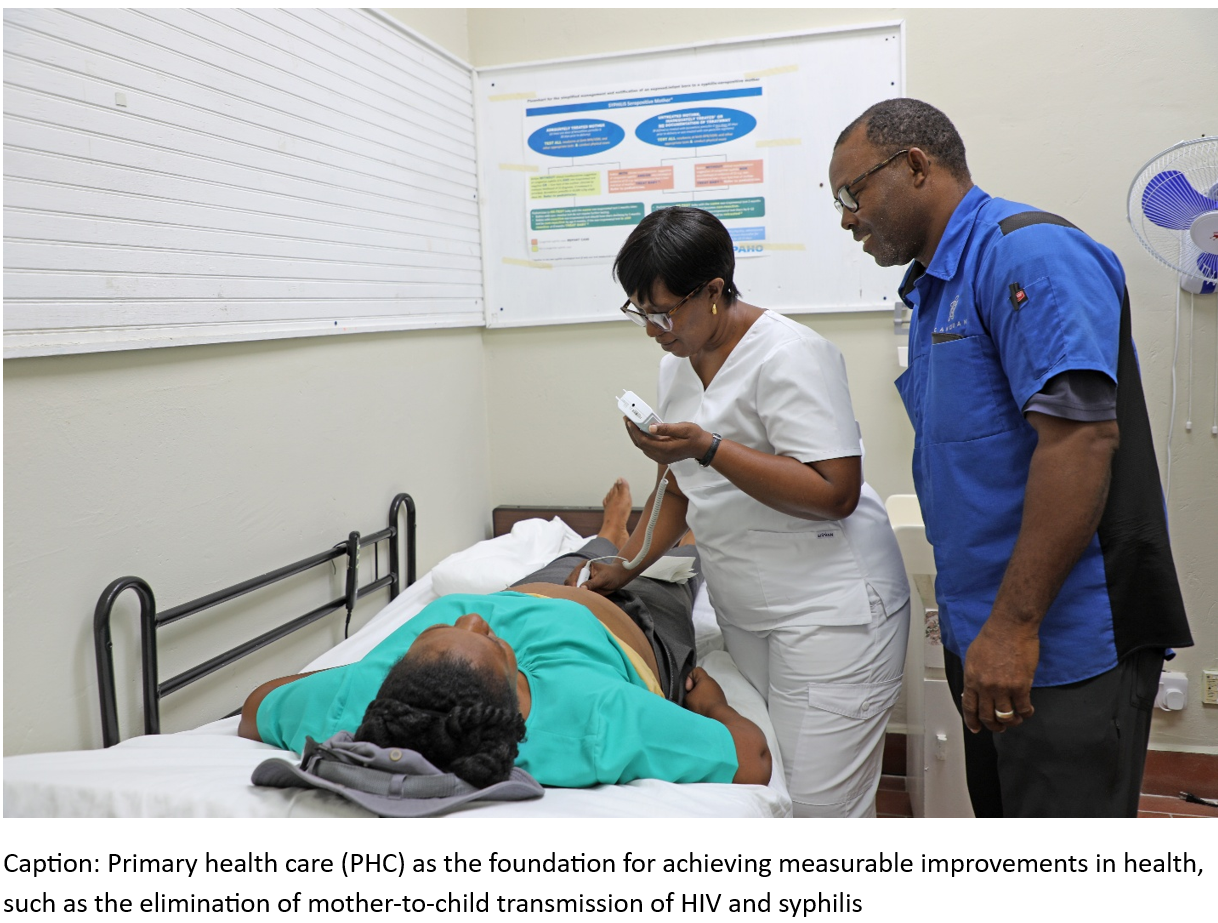
Strengthening PHC as the cornerstone of service delivery has contributed to measurable improvements in the resolution capacity of the first level of care and reductions in avoidable hospitalizations.
In Brazil, Chile, Costa Rica and Mexico, sustained declines in hospitalizations for ambulatory care-sensitive conditions reflected stronger preventive care and chronic disease management at the primary care level. In Honduras, analyses of avoidable hospitalizations were used to reorganize PHC services linked to 25 public hospitals and to guide targeted investments in diabetes and hypertension management. In Jamaica, technical cooperation supported the definition of an essential PHC benefits package, helping to clarify service entitlements and strengthen alignment between financing and service delivery.
Progress was consolidated through the advancement of integrated health service delivery networks (IHSDNs) as a core strategy to reduce fragmentation. More than 10 countries strengthened their IHSDN frameworks. In Chile, integration efforts under the national care policy improved referral coordination and continuity of care across service levels.
Stewardship for PHC reform was strengthened through structured policy dialogue and multisectoral engagement. The Alliance for Primary Health Care in the Americas, a joint initiative of PAHO, the World Bank and the Inter-American Development Bank, gained five new member countries during the biennium: the Dominican Republic and El Salvador in 2024, and Chile, Panama, and Paraguay in 2025. These countries have established permanent national coordination mechanisms linking ministries of health and finance, thereby reinforcing fiscal sustainability and institutional ownership of PHC-centered transformation. Together, these advances positioned PHC as the foundation of resilient and cost-effective health systems across the Americas.
Regional self‑reliance strengthened through expanded access to medicines, vaccines, and other health technologies
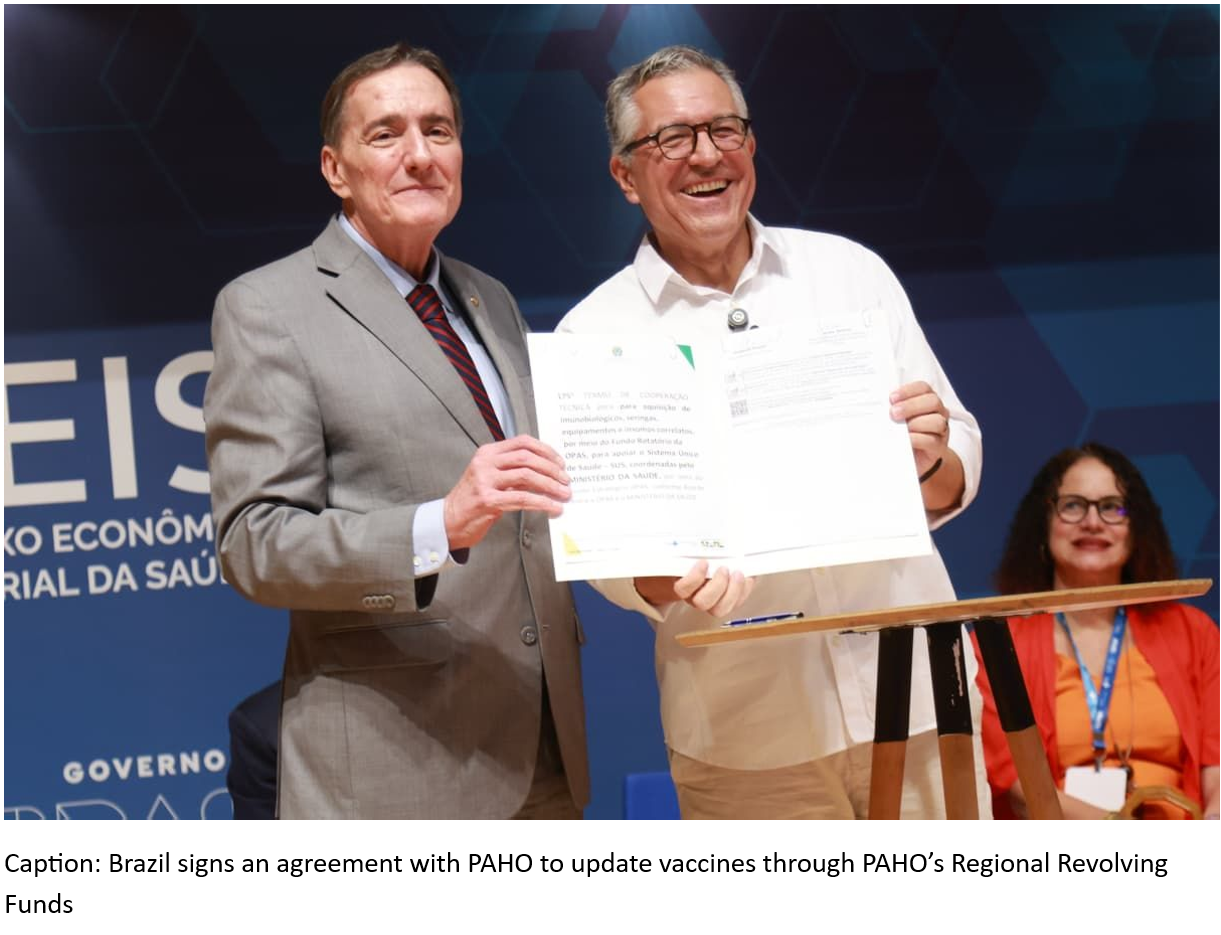
Progress toward health self-reliance accelerated during the 2024–2025 biennium as countries expanded access to medicines, vaccines, diagnostics, and other health technologies. PAHO supported these advances through pooled procurement, regulatory strengthening, and regional production initiatives, reinforcing collective capacity to meet health needs more sustainably.
Regional production and supply chain resilience advanced through technology transfer and manufacturing partnerships. Argentina and Brazil expanded production capacity using mRNA platform technologies, reducing dependence on external suppliers for critical technologies. At the same time, participation by regional manufacturers in pooled procurement increased significantly, providing greater flexibility in the use of PAHO’s Regional Revolving Funds (RRF) to incentivize regional innovation and manufacturing. As a result, regional producers now represent a growing share of the RRF portfolio, strengthening supply security and diversification.
 Through the RRF, uninterrupted access to essential health products was secured at scale. During the biennium, the RRF procured more than 464 million vaccine doses, 112 million injection devices, 23 million diagnostic tests, 10 million treatments, and 2 million vector control supplies, and facilitated over 4500 deliveries. These shipments represented an estimated total transaction value of USD 1.7 billion for the biennium and contributed to protecting around 135 million people through vaccine delivery and providing treatment, diagnostics and vector control supplies to an estimated 35 million people.
Portfolio modernization further expanded access to high-cost medicines, pediatric oncology products and next-generation vaccines, delivering substantial price reductions and improving affordability for national programs. Five new high-cost treatments for cancer and multiple sclerosis were incorporated – enzalutamide, abiraterone, palbociclib, cladribine, and glatiramer acetate – enabling price reductions of up to 90% compared with country-reported prices.
These actions directly contributed to strengthening the regional manufacturing ecosystem, improving supply security, and accelerating technological diversification. Regulatory convergence and health technology assessment capacities were also strengthened, improving oversight, transparency, and evidence-based decision-making. Collectively, these advances positioned health self-reliance as a strategic pillar of regional resilience.
With PHC as the cornerstone of service delivery, PASB worked with countries in achieving measurable improvements in first-level resolution capacity and reductions in avoidable hospitalizations, as well as achievements in health system performance, continuity of care, and service integration, including the following:
Brazil, Chile, Costa Rica, and Mexico reported declines in avoidable hospitalizations reflecting stronger preventive and chronic care management at the first level of care. In Honduras, the use of avoidable hospitalization analysis informed the reorganization of PHC services linked to 25 public hospitals, guiding targeted investments in diabetes and hypertension management.
Six countries (Brazil, Colombia, Honduras, Mexico, Paraguay, and Peru) have optimized evidence-based decision-making tools and processes to strengthen service delivery through a territorial approach. For example, Honduras used georeferencing analysis to correlate coverage to reduce maternal mortality while Paraguay used this information to map service gaps, optimize catchment areas, and prioritize investments in underserved districts.
Five countries (Chile, Dominican Republic, El Salvador, Panama, and Paraguay) were participating in the Alliance for Primary Health Care in the Americas during the biennium. The Alliance, a joint initiative of PAHO, the World Bank, and the Inter-American Development Bank (IDB) launched in 2023, aims to support the acceleration of PHC initiatives in all countries of the Region through improved PHC investment, innovation and implementation. Several of these countries have already leveraged financing from the IDB and the World Bank to renovate health centers, buy new equipment, implement telehealth and telemedicine services, and train healthcare workers.
Several countries progressed in developing and implementing policies, strategies, and plans that support access to comprehensive and quality PHC. Twenty-six countries and territories adopted or updated PHC policies, and thirteen implemented empanelment systems, a tool to assign responsibility for a defined population to primary care teams or facilities. Eighteen countries now have frameworks for integrated health service delivery networks (IHSDN), integrating priority programs, including NCDs and disease elimination, into PHC. This was supported by the launch of an updated IHSDN framework and an IHSDN network (IMPULSA-RISS) in November 2025, with ten countries participating at its inception. Thirteen countries reported implementing strategies or plans of action to improve quality in health service delivery.
Challenges included the following factors that hindered performance:
Before the IHSDN framework was launched, the lack of such a framework limited countries’ ability to reorganize services around PHC, integrate NCDs, and leverage digital health solutions in a coherent manner, slowing the scale-up of network-based reforms.
Despite recent improvements such as the use of georeferencing and digital dashboards, fragmentation in data collection and performance monitoring across programs constrained the ability to assess progress consistently.
Uneven progress in service delivery, health workforce development, and information systems has delayed implementation of integrated care models in several countries.
The Bureau's leadership, normative guidance, and technical cooperation elevated health governance and financing as strategic levers, resulting in concrete achievements, including the following:
Eighteen countries advanced in the implementation of the Essential Public Health Functions (EPHF) approach with defined follow-up actions, while ten developed action plans to strengthen EPHF as a direct result of national or subnational assessments. Adoption of the Strategy for Strengthening the EPHF in 2024 and establishment of the Regional Network on Governance and Essential Public Health Functions supported these efforts, creating a shared framework for capacity development, including technical guidelines and tools.
Brazil, Chile, Colombia, Mexico, Peru, and Uruguay, which have among the largest funds and public institutions responsible for health system financing in the Region, strengthened alignment between technical priorities and financial management through the National Health Funds Network of the Americas, facilitated by PASB.
Colombia, Costa Rica, Dominican Republic, Panama, Paraguay, and Peru advanced health financing reforms while Barbados, Dominica, Grenada, Saint Kitts and Nevis, Saint Lucia, and Saint Vincent and the Grenadines finalized plans to improve collection and pooling through policy proposals to adopt national health insurance schemes awaiting parliament approval.
The Plurinational State of Bolivia, Chile, Paraguay, and Peru developed in-depth country studies using microdata to reinforce the evidence base on out-of-pocket‑ expenditure and generate policy recommendations to improve financial protection.
The flagship report of the World Bank/PAHO/Lancet Regional Health Americas Commission was launched during the biennium, contributing to improved evidence base for PHC and resilient health systems.
Challenges reflected persistent structural and political constraints:
While most countries have foundational PHC policies, plans, and frameworks, supported by guidance and tools from PASB, in many cases, these are not yet operationalized at scale.
EPHF plans were not consistently translated into sustained investments. Assessment results indicate moderate or limited capacity in critical areas such as health research and intersectoral action, signaling ongoing challenges in institutionalizing and scaling EPHF improvements that can be confronted by applying recently developed strategy and network.
Progress in institutionalization of health spending and financial protection data production was affected due to insufficient prioritization of investments in health, as well as technical complexity. The lack of stable funding, routine data access, and skilled staff undermined reliable and timely evidence for decision-making.
Building on previous gains, PAHO advanced and supported a life course vision for integrated PHC, generating achievements in continuity of care across age groups, including:
Since 2022, the maternal mortality ratio showed a decrease in 10 of 12 countries prioritized by PAHO for action through institutional coordination and accelerated technical cooperation: the Plurinational State of Bolivia, Brazil, Colombia, Guatemala, Haiti, Honduras, Jamaica, Mexico, Paraguay, and Peru. For example, Honduras reduced maternal mortality by 41.5%, declining from 65 maternal deaths per 100,000 live births in 2023 to 38 in 2025. This reduction was driven by an integrated territorial response that was informed by georeferencing analysis mapping of maternal deaths by municipality. The approach enhanced capacity to identify gaps in service coverage and access and better target actions to strengthen the clinical, operational, and logistical interventions, demonstrating an effective way forward in response to the call to action for zero preventable maternal deaths, which was launched in 2024.
Country capacity to deliver integrated, people‑centered health services for children and adolescents expanded by scaling implementation of internationally recognized standards for early development, including increased availability of policy packages. Eleven countries conducted periodic developmental assessments as part of health services for children, and 15 countries were implementing strategies to improve access for adolescents to quality health services.
Brazil, Chile, Costa Rica, Ecuador, Mexico, and Turks and Caicos implemented Integrated Care for Older People (ICOPE) models. In addition, in line with the Policy on Long-term Care (LTC) that was approved by Member States in 2024, significant progress was made in strengthening the evidence for LTC policies and services, including policy recommendations related to LTC financing and workforce organization. In Brazil, Chile, and Costa Rica, interministerial actions––particularly involving Ministries of Health––supported the development of care policies and services. In Sint Maarten, PASB supported the first baseline assessment of the enabling environment for healthy aging.
One hundred and twelve cities and communities from the Region joined the Global Network of Age-Friendly Cities and Communities, which grew substantially during the biennium, including first-time participation from Ecuador, Guatemala, Martinique, and Saint Kitts and Nevis. This brings the Region’s participation to over 1000 cities and communities, which represents over 50% of all members.
Challenges arose from the capacity of health systems to keep up with the pace of demographic and epidemiological change.
While normative guidance and technical cooperation for maternal mortality reduction are well established, such as on quality of care and maternal death surveillance and response, translating these into sustained system-wide improvements in priority countries has proven challenging. Constraints include uneven absorptive capacity, variability in the use of surveillance systems, and limitations in coordinated follow-up at subnational levels.
Rapid population aging exposed gaps in service readiness, long-term‑ care, financing, data availability, and intersectoral collaboration to position healthy aging within health systems transformation.
The Bureau's technical cooperation strengthened health workforce governance, planning, and capacity development, generating achievements that support service delivery reform, including the following:
Strategic and political positioning of health workforce increased, with a reference framework for national health workforce policies that was broadly agreed upon by 23 countries in the Region, providing a shared, evidence-based guide for formulating and implementing health workforce policies, aligned with the Policy on the Health Workforce 2030. Health workforce remained a high priority in the subregional cooperation agenda, with a roadmap for the health workforce approved by the Caribbean Community (CARICOM). Furthermore, several countries advanced in health workforce plans. Jamaica, for instance, developed a national health workforce policy and plan, supported by data improvements and labor‑market analysis, improving the health system’s capacity to deliver quality services.
Structured policy dialogues strengthened governance for nursing and midwifery, aligning priorities and informing national and subregional workforce plans in Mexico and 17 Caribbean countries and territories.
Learning pathways on the PAHO Virtual Campus for Public Health scaled continuous professional development in priority areas, reaching 4.4 million users and 11.25 million enrollments, with growth accelerating even greater than during the pandemic period.
A regional roadmap on the ethical management of health workforce migration was endorsed by 18 countries in the Americas and 2 in Europe.
Despite progress, structural and systemic challenges continued to constrain workforce availability, stability, and policy uptake:
Persistent workforce shortages continued to limit access to services, particularly in underserved and remote areas, despite increased policy attention and technical guidance.
Even as health workforce remains a priority, thanks in part to PAHO’s policy dialogue for the adoption and implementation of measures to strengthen health workforce, uptake of normative guidance and strategies faces competing priorities at the national level.
The Bureau's technical cooperation and engagement with national authorities and other stakeholders resulted in achievements in access to medicines, vaccines, and other health technologies, such as the following:
Regional Research and development and production capacities expanded, with advances including messenger RNA (mRNA) platforms applied to priority vaccines (including leishmaniasis and influenza H5) and the incorporation of new infrastructure and specialized equipment in Argentina and Brazil, further strengthening South‑South cooperation. At the same time, participation of regional manufacturers in the RRFs greatly increased, providing more flexibility in the use of the funds to incentivize regional innovation and manufacturing. As a result, regional producers now represent a growing share of the RRF portfolio, strengthening supply security and diversification.
During the biennium, the RRF procured more than 464 million vaccine doses, 112 million injection devices, 23 million diagnostic tests, 10 million treatments, and 2 million vector control supplies and facilitated over 4,500 deliveries. These shipments represented an estimated total transaction value of US $1.7 billion for the biennium and contributed to protecting around 135 million people through vaccine delivery and providing treatment, diagnostics, or vector control supplies to cover an estimated 35 million people. Portfolio modernization further expanded access to high-cost medicines, pediatric oncology products, and next generation vaccines, delivering substantial price reductions and improving affordability for national programs. Five new high-priced treatments for cancer and multiple sclerosis were incorporated, enabling price reductions of up to 90% relative to country reported prices.
As an example of progress at country level, Argentina expanded access to medicines and vaccines while achieving more than $27 million in savings through the RRFs, with strengthened procurement efficiency and access to essential health technologies.
Access to high‑cost and specialized health technologies improved through integrated approaches, supported by adoption of the regional policy related to high‑cost and high-price health technologies; and scaled support to the PAHO Better Care for NCDs initiative and PAHO Disease Elimination initiative.
Advances were also made across transplant, blood, radiological, and pharmaceutical services. Seventeen countries reviewed national blood transfusion systems, with PASB supporting efforts to eliminate transfusion-transmitted infections. Thirteen countries strengthened control of radiation sources and radiation-generating equipment, supported by collaboration between PAHO and the International Atomic Energy Agency in implementing the San José Action Plan. Finally, several countries applied a new regional tool to assess pharmaceutical services quality.
By December 2025, 21 countries initiated a regulatory self-assessment process using the Global Benchmarking Tool, either independently or through benchmarking with PASB support.
Structural, financial, and coordination challenges continue to limit the pace and scale of access to health technologies across the Region.
Despite the great progress made during the period, limited investment in regional research and development, production ecosystems, and regulatory systems, combined with technology transfer constraints, continues to slow innovation, uptake of new technologies, and expansion of manufacturing capacities.
Bottlenecks in introducing new products into the RRFs, compounded by limited awareness of the portfolio, reduced PASB’s ability to fully leverage pooled procurement to support countries in expanding access to strategic public health supplies.
* Countries and territories that did not complete the assessment or for which there was no consensus on the assessment results are not reflected in the final ratings for the indicator.