| Indicator assessment Outcomes | Indicator assessment Outputs | Approved Budget 24-25 US$ M | % Funds Available vs PB | % Implementation funds available |
|
|---|---|---|---|---|---|
| 18. Social and environmental determinants | 18.6 | 101% | 93% | ||
| 18.6 | 101% | 93% | |||
| 18.6 | 101% | 93% | |||
| 18.6 | 101% | 93% | |||
| 18.6 | 101% | 93% | |||
| 18.6 | 101% | 93% | |||
| 18.6 | 101% | 93% | |||
| 18.6 | 101% | 93% | |||
| 18.6 | 101% | 93% | |||
| 18.6 | 101% | 93% | |||
| 18.6 | 101% | 93% | |||
| 18.6 | 101% | 93% | |||
| 18.6 | 101% | 93% | |||
| 18.6 | 101% | 93% | |||
| 18.6 | 101% | 93% | |||
| 18.6 | 101% | 93% | |||
| 18.6 | 101% | 93% | |||
| 18.6 | 101% | 93% | |||
| 18.6 | 101% | 93% | |||
| 18.6 | 101% | 93% | |||
| 18.6 | 101% | 93% | |||
| 18.6 | 101% | 93% | |||
| 18.6 | 101% | 93% | |||
| 18.6 | 101% | 93% | |||
| 18.6 | 101% | 93% | |||
| 18.6 | 101% | 93% | |||
| 18.6 | 101% | 93% | |||
| 18.6 | 101% | 93% | |||
| 18.6 | 101% | 93% | |||
| 18.6 | 101% | 93% | |||
| 18.6 | 101% | 93% | |||
| 18.6 | 101% | 93% | |||
| 18.6 | 101% | 93% | |||
| 18.6 | 101% | 93% | |||
| 18.6 | 101% | 93% | |||
| 18.6 | 101% | 93% | |||
| 18.6 | 101% | 93% | |||
| 18.6 | 101% | 93% | |||
| 18.6 | 101% | 93% | |||
| 18.6 | 101% | 93% | |||
| 18.6 | 101% | 93% | |||
| 18.6 | 101% | 93% | |||
| 18.6 | 101% | 93% | |||
| 18.6 | 101% | 93% | |||
| 18.6 | 101% | 93% | |||
| 18.6 | 101% | 93% | |||
| 18.6 | 101% | 93% | |||
| 18.6 | 101% | 93% | |||
| 19. Health promotion and intersectoral action | 7.1 | 80% | 100% | ||
| 7.1 | 80% | 100% | |||
| 7.1 | 80% | 100% | |||
| 7.1 | 80% | 100% | |||
| 7.1 | 80% | 100% | |||
| 7.1 | 80% | 100% | |||
| 7.1 | 80% | 100% | |||
| 7.1 | 80% | 100% | |||
| 7.1 | 80% | 100% | |||
| 7.1 | 80% | 100% | |||
| 7.1 | 80% | 100% | |||
| 7.1 | 80% | 100% | |||
| 7.1 | 80% | 100% | |||
| 7.1 | 80% | 100% | |||
| 7.1 | 80% | 100% | |||
| 7.1 | 80% | 100% | |||
| 7.1 | 80% | 100% | |||
| 7.1 | 80% | 100% | |||
| 7.1 | 80% | 100% | |||
| 7.1 | 80% | 100% | |||
| 7.1 | 80% | 100% | |||
| 7.1 | 80% | 100% | |||
| 7.1 | 80% | 100% | |||
| 7.1 | 80% | 100% | |||
| 7.1 | 80% | 100% | |||
| 7.1 | 80% | 100% | |||
| 26. CCTs: equity, gender, ethnicity, and human rights | 7.8 | 105% | 78% | ||
| 7.8 | 105% | 78% | |||
| 7.8 | 105% | 78% | |||
| 7.8 | 105% | 78% | |||
| 7.8 | 105% | 78% | |||
| 7.8 | 105% | 78% | |||
| 7.8 | 105% | 78% | |||
| 7.8 | 105% | 78% | |||
| 7.8 | 105% | 78% | |||
| 7.8 | 105% | 78% | |||
| 7.8 | 105% | 78% | |||
| 7.8 | 105% | 78% | |||
| 7.8 | 105% | 78% | |||
| 7.8 | 105% | 78% | |||
| 7.8 | 105% | 78% | |||
| 7.8 | 105% | 78% | |||
| 7.8 | 105% | 78% | |||
| 7.8 | 105% | 78% | |||
| 7.8 | 105% | 78% | |||
| 7.8 | 105% | 78% | |||
| 7.8 | 105% | 78% | |||
| 7.8 | 105% | 78% | |||
| 7.8 | 105% | 78% | |||
| 7.8 | 105% | 78% | |||
| 7.8 | 105% | 78% | |||
| 7.8 | 105% | 78% | |||
| 7.8 | 105% | 78% | |||
| 7.8 | 105% | 78% | |||
| 7.8 | 105% | 78% | |||
| 7.8 | 105% | 78% |
Adoption of scalable approaches strengthened to address determinants of health
During the 2024–2025 biennium, countries demonstrated the feasibility and scalability of approaches to address the social and environmental determinants of health through institutionalized, decision-oriented, and sustainable approaches. PAHO advanced the adaptation and implementation of an operational framework for monitoring the determinants and related policies, with a focus on strengthening information systems that support intersectoral decision-making, accountability, and action across levels of governance.
In the Brunca region of Costa Rica, an operational framework for the social determinants of health was implemented across 6 health areas and 77 basic integrated health care teams. This strengthened capacity to act on social determinants in coordination with local governments and territorial actors. As a direct result of this implementation, the Costa Rican Social Security Fund formally expressed interest in institutionalizing and scaling the framework nationwide, demonstrating its operational viability and potential for wider national adoption.
 Elsewhere, PAHO provided sustained technical leadership to support territorial health strategies across 23 municipalities with over 1.5 million inhabitants and 3 capital cities with over 20 million inhabitants across 6 countries (Chile, Colombia, Costa Rica, Ecuador, Mexico, and Peru). These strategies were adapted to diverse local priorities and governance contexts, reinforcing intersectoral coordination and action. Their scalability was further supported through the expansion of the Movement of Healthy Municipalities, Cities and Communities, which provides an enabling framework for institutionalizing local action on priority public health initiatives.
Environmental determinants were also addressed through scalable actions that strengthened health system resilience and reduced risk exposure. During the biennium, more than 450 000 people gained access to cleaner household energy for cooking, while the application of PAHO air quality and urban health tools in 25 cities guided investments that improved air quality, reduced greenhouse gas emissions, expanded green spaces and enhanced active mobility systems for more than 80 million people. Expanded access to safely managed water and sanitation services enabled 22 million additional people to benefit from improved water, sanitation, and hygiene (WASH) conditions, while 1.37 million fewer people practiced open defecation between 2023 and 2024.
PAHO’s contribution in this area strengthened health promotion and intersectoral action, including Health in All Policies approaches, contributing to achievements, such as the following:
Fourteen countries established health promotion policies or frameworks, and seven countries (Belize, Bolivia [Plurinational State of], Canada, Costa Rica, Ecuador, Grenada and Honduras) incorporated health promotion into health or development plans. Building on subregional dialogue and large-scale capacity-building (over 119 000 participants in a Virtual campus for Public Health course), PASB supported institutionalization of health promotion during the biennium, in line with the strategy and plan of action on health promotion.
Engagement with local governments was scaled through the Movement of Healthy Municipalities, Cities and Communities, involving more than 4,000 local authorities across 17 countries, 15 networks, 20 ministries of health, and the addition of 400 cities in 2025 following a formal agreement with Mercociudades. For example, Cuba expanded the movement to 94 municipalities, strengthening intersectoral governance and local action on health and well-being.
A regional framework for monitoring intersectoral action and Health in All Policies in the Americas advanced, with indicators agreed with 10 countries. Regional collaboration was consolidated through the formalization of a network on intersectoral action, bringing together 47 institutions from 13 countries and strengthening cross‑country knowledge exchange.
However, challenges limited the depth and consistency of implementation:
While the need has been acknowledged to engage sectors beyond health – such as education, housing, labor, social protection, environment, and finance – such engagement tended to be limited to seeking ad hoc support for health-led initiatives as opposed to genuine intersectoral integration.
In many contexts, health promotion remains narrowly focused on individual and behavioral interventions, such as campaigns, limiting attention to advancing public policy, intersectoral governance, community participation, and action on the determinants.
PAHO focused on strengthening capacity to address disparities related to the cross-cutting themes, contributing to achievements such as the following:
Twenty-six countries and territories improved capacities to generate, analyze, and use data to inform targeted action on reducing health gaps and advancing health priorities. A health for all perspective was also integrated into surveillance tools and analytical guidance addressing the determinants, including environmental challenges such as air pollution, strengthening evidence‑based decision‑making to reduce avoidable gaps.
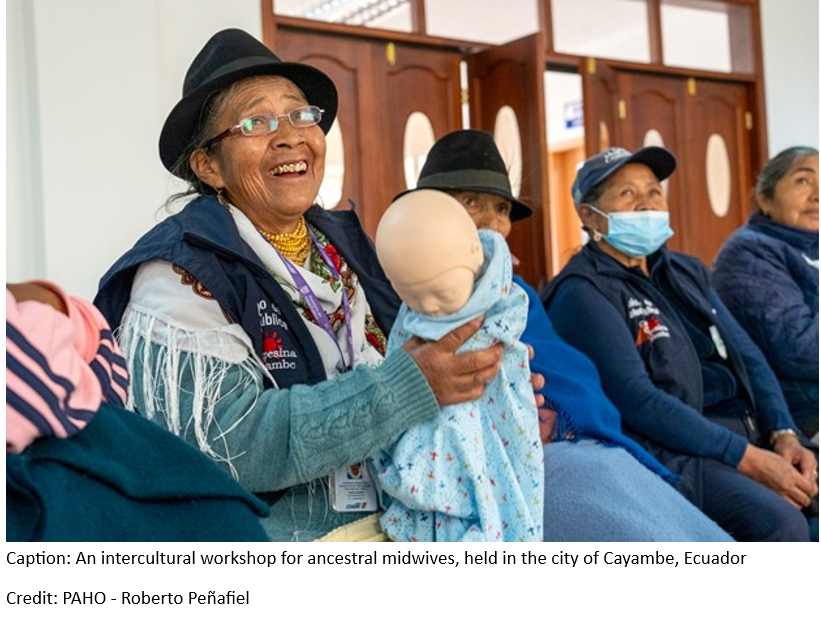
Multiple countries advanced intercultural approaches to health challenges, with support from PASB through digital products, technical guidance, regional consultations with Indigenous youth, and targeted training. In Peru, for example, knowledge dialogues were embedded in health policy and operationalized through service delivery models such as at Atalaya Hospital, which improved access and quality of care for Indigenous populations. Paraguay also implemented an intercultural model of care, expanding access to maternal, neonatal, and family health services for Indigenous, rural, and border populations.
The Region made progress in addressing health in contexts of deprivation of liberty, supported by PAHO’s normative guidance (including guidelines for responding to tuberculosis, HIV, STIs, and viral hepatitis) and promotion of joint planning between health and justice sectors. In Colombia, a specialized tool was implemented at selected detention centers, including facilities for women, men, and minors, to assess and respond to health needs.
However, challenges affected the effective application of cross-cutting themes, such as the following:
Siloed approaches to addressing the topics under this outcome reduced efficiency and impact, which the integrated approach to advancing health for all in the SP26-31 aims to address.
Political and contextual factors affected the explicit adoption of approaches related to disparities in some contexts.
* Countries and territories that did not complete the assessment or for which there was no consensus on the assessment results are not reflected in the final ratings for the indicator.