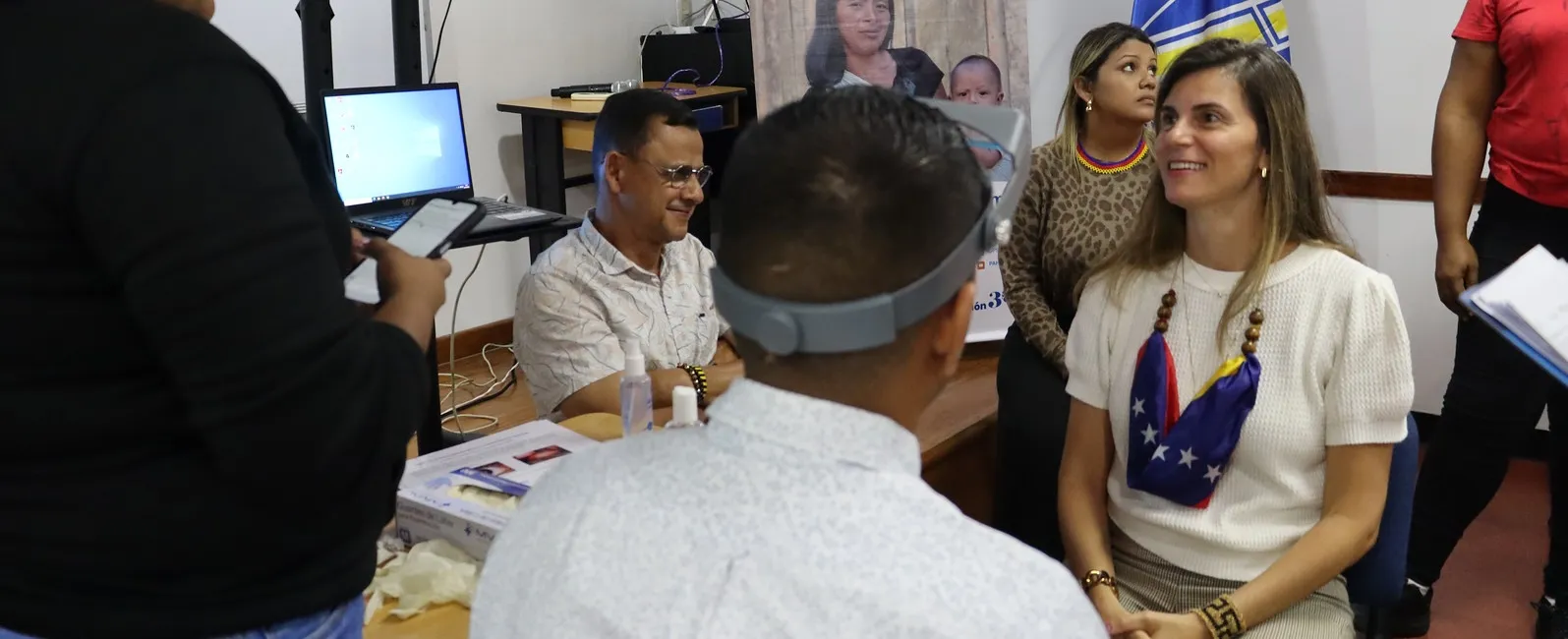
During the 2024–2025 biennium, PAHO played a key role in restoring Venezuela’s access to PAHO’s Regional Revolving Funds for the procurement of essential vaccines, after seven years of inactivity.
During the biennium, PAHO supported the strengthening of public healthcare system capacities by training more than 23 000 professionals from various sectors, including personnel from the Ministry of People’s Power for Health, the education sector, and civil protection.
PAHO contributed to strengthening the Venezuelan health system by promoting the organization of comprehensive community health areas and the development of integrated health service networks (IHSNs).
During the 2024–2025 biennium, PAHO led the start of the technical process for the introduction of the human papillomavirus (HPV) vaccine in Venezuela as a strategic step toward the elimination of cervical cancer. It provided technical assistance for planning the vaccine’s introduction and supported the design of the national immunization strategy, strengthening the country’s capacity to expand population protection. This effort was complemented by the mobilization of international resources that will allow progress toward later phases of implementation.
During the 2024–2025 biennium, PAHO facilitated access to essential health services for 142 764 people affected by the protracted crisis in Venezuela by mobilizing resources and implementing projects for humanitarian health response.
| Outcome Indicator | Baseline/Target | Rating |
|---|---|---|
| 01.b. Number of countries and territories that have implemented strategies to strengthen the response capacity of the first level of care | Target 2025 | Partially achieved |
| 07.a. Number of countries and territories that have reduced the density gap with respect to physicians, nurses, and midwives, achieving at least 25 health workers per 10,000 population in underserved areas, keeping in mind the global target of 44.5 by 2030 | Baseline 2019 | Not achieved |
| 07.b. Number of countries that have an interprofessional health team at the first level of care, consistent with their model of care | Baseline 2019 | Achieved |
| Outcome Indicator | Baseline/Target | Rating |
|---|---|---|
| 04.e. Number of countries with >70% of malaria cases diagnosed and treated within 72 hours of the start of symptoms | Target 2025 | Achieved |
| 04.f. Number of countries and territories with capacity to conduct integrated surveillance of arbovirus cases | Target 2025 | Partially achieved |
| 12.a. Number of countries and territories reporting data on discrimination in health services experienced by men who have sex with men (MSM) in the past 12 months | Baseline 2019 | Discrepancy |
| 12.b. Number of countries and territories where the entire endemic (by vector transmission) territory or territorial unit has a domestic infestation index (by the main triatomine vector species or by the substitute vector, as the case may be) of less than or equal to 1% | Target 2025 | Not achieved |
| 17.c [b]. Interruption of transmission of neglected infectious diseases (NID) in countries, following WHO criteria and guidelines [Chagas Disease] | Target 2025 | Not achieved |
| 17.c [c]. Interruption of transmission of neglected infectious diseases (NID) in countries, following WHO criteria and guidelines [Dog-mediated human rabies] | Baseline 2019 | Discrepancy |
| 17.c [f]. Interruption of transmission of neglected infectious diseases (NID) in countries, following WHO criteria and guidelines [Onchocerciasis] | Target 2025 | Discrepancy |
| 17.d. Number of countries and territories with established capacity and effective processes to eliminate human rabies transmitted by dogs | Target 2025 | Discrepancy |
| 17.e. Number of countries and territories in which endemic transmission of measles or rubella virus has been reestablished | Baseline 2019 | Achieved |
| Outcome Indicator | Baseline/Target | Rating |
|---|---|---|
| 05.e. Number of countries and territories whose surveillance systems have the capacity to report on key indicators of the Global Monitoring Framework for Noncommunicable Diseases | Baseline 2019 | Partially achieved |
| Outcome Indicator | Baseline/Target | Rating |
|---|---|---|
| 21.b. Number of countries and territories that generate, analyze, and use data and information according to health priorities, disaggregated by geopolitical and demographic strata, as appropriate to the national context | Target 2025 | Partially achieved |
| Outcome Indicator | Baseline/Target | Rating |
|---|---|---|
| 23.a. Number of countries and territories that meet or exceed minimum capacities to manage public health risks associated with emergencies | Baseline 2019 | Partially achieved |
| 23.b. Number of States Parties meeting and sustaining International Health Regulations (IHR) requirements for core capacities | Target 2025 | Partially achieved |
| 24.a. Number of countries and territories with installed capacity to effectively respond to major epidemics and pandemics | Target 2025 | Achieved |
| 24.b. Number of endemic countries and territories with ≥ 80% coverage for yellow fever vaccine | Target 2025 | Partially achieved |
| Outcome Indicator | Baseline/Target | Rating |
|---|---|---|
| 27.a. Proportion of countries and territories where the national health authority reports satisfaction with PAHO/WHO’s leading role on global and regional health issues | Target 2025 | Achieved |
| 27.b. Number of countries and territories for which there is alignment between the national health policy, strategy, or plan and the outcomes defined in the PAHO Strategic Plan 2020-2025 | Baseline 2019 | Achieved |
1. Access to comprehensive and quality health services
4. Response capacity for communicable diseases
5. Access to services for NCDs and mental health conditions
7. Health workforce
12. Risk factors for communicable diseases
17. Elimination of communicable diseases
21. Data, information, knowledge, and evidence
23. Health emergencies preparedness and risk reduction
24. Epidemic and pandemic prevention and control
27. Leadership and governance
| Output (OPT) Indicator | Baseline/Target | Rating |
|---|---|---|
| 01.1.a. Number of countries and territories with frameworks in place for integrated health service delivery networks (IHSDN) to improve the resolution capacity of the first level of care and integrate priority programs, including NCDs and the elimination agenda | Baseline 2023 | Achieved |
| 07.1.a. Number of countries and territories that are implementing a national policy on human resources for health | Baseline 2023 | Partially achieved |
| 07.2.a. Number of countries and territories with a norm that defines the capacities and scope of practice of inter-professional teams at the first level of care | Baseline 2023 | Achieved |
| 07.3.a. Number of countries and territories enabled to strengthen health workforce competencies and capacity-building programs through the Virtual Campus for Public Health and other WHO platforms | Target 2025 | Achieved |
| Output (OPT) Indicator | Baseline/Target | Rating |
|---|---|---|
| 04.1.a. Number of countries and territories implementing national norms, standards, and tools aligned with PAHO and WHO guidelines on TB, HIV, STIs, and VH, with emphasis on key and vulnerable populations | Target 2025 | Partially achieved |
| 04.2.a. Number of countries and territories implementing the new arboviral disease guidelines for patient care in the Region of the Americas | Baseline 2023 | Achieved |
| 04.3.a. Number of NID-endemic countries and territories that implement PAHO recommendations on integrated interventions to reduce the burden of NIDs through their health systems | Target 2025 | Partially achieved |
| 04.4.a. Number of countries and territories that implement PAHO/WHO recommended policies and inter programmatic approaches related to malaria | Baseline 2023 | Achieved |
| 04.5.a. Number of countries and territories with DPT3 immunization coverage of at least 95% that are implementing strategies to reach unvaccinated and under-vaccinated populations | Target 2025 | Not achieved |
| 12.6.a. Number of NID-endemic countries and territories that use the framework of the WHO WASH-NTD strategy as part of their national or subnational approach to tackle NIDs | Target 2025 | Achieved |
| 12.8.a. Number of countries and territories that have programs to prevent or mitigate zoonotic diseases and snake/arthropod envenoming | Target 2025 | Partially achieved |
| 17.1.a. Number of countries and territories implementing PAHO/WHO-recommended interventions in active foci and areas at risk of reestablishment of malaria | Baseline 2023 | Achieved |
| 17.3.a. Number of countries and territories that administer hepatitis B vaccine to newborns during the first 24 hours | Baseline 2023 | Achieved |
| 17.4.a. Number of countries and territories with official status as foot-and-mouth disease free, with or without vaccination, in accordance with the timeline and expected results established in the PHEFA Action Plan 2021–2025 | Target 2025 | Not achieved |
| 17.5.a. Number of countries and territories that have maintained their status as free from both wild poliovirus and circulating vaccine-derived poliovirus | Target 2025 | Achieved |
| 17.8.a. Number of countries and territories implementing plans of action to strengthen prevention, prophylaxis, surveillance, and control for the validation of the elimination of rabies transmitted by dogs | Target 2025 | Discrepancy |
| Output (OPT) Indicator | Baseline/Target | Rating |
|---|---|---|
| 05.1.a. Number of countries and territories that are implementing evidence-based national guidelines/protocols/standards for the management of NCDs (i.e. cardiovascular disease, cancer, diabetes, and chronic respiratory disease) | Target 2025 | Achieved |
| 06.2.a. Number of countries and territories that are implementing national standard operating procedures, protocols, and/or guidelines for the health system response to violence, aligned with PAHO and WHO guidelines | Target 2025 | Discrepancy |
| 13.1.d. Number of countries and territories implementing policies and/or actions to regulate unhealthy food and drink products | Target 2025 | Achieved |
| 13.1.e. Number of countries and territories covered by best-practice policies to eliminate industrially produced trans-fatty acids in the food supply | Target 2025 | Partially achieved |
| 13.1.f. Number of Member States that have implemented the four major demand-reduction measures in the WHO Framework Convention on Tobacco Control (FCTC) at the highest level of achievement | Baseline 2023 | Achieved |
| 15.2.a. Number of countries and territories that have a national multisectoral coalition/task force to prevent and respond to violence that includes the health sector | Baseline 2023 | Discrepancy |
| 16.1.a. Number of countries and territories implementing policies and legislative frameworks to promote and improve mental health in line with global human rights instruments | Target 2025 | Achieved |
| Output (OPT) Indicator | Baseline/Target | Rating |
|---|---|---|
| 19.4.b. Number of countries and territories implementing mechanisms that facilitate the participation of community organizations and leaders in public health programs | Baseline 2023 | Achieved |
| 26.2.a. Number of countries and territories implementing policies, plans, and strategies to advance health equity | Target 2025 | Partially achieved |
| 26.3.a. Number of countries and territories implementing policies, plans, and programs to advance gender equality in health | Target 2025 | Partially achieved |
| 26.4.a. Number of countries and territories implementing policies, plans, and programs to advance ethnic equality in health | Baseline 2023 | Partially achieved |
| 26.5.a. Number of countries and territories using human rights norms and standards in the formulation and implementation of health-related policies, plans, programs, and legislation | Baseline 2023 | Partially achieved |
| Output (OPT) Indicator | Baseline/Target | Rating |
|---|---|---|
| 21.2.a. Number of countries and territories with mechanisms (policies, standards, tools, etc.) in place for the generation, dissemination, and preservation of, and access to, scientific and technical data, information, and evidence for health | Baseline 2023 | Achieved |
| Output (OPT) Indicator | Baseline/Target | Rating |
|---|---|---|
| 23.2.a. Number of States Parties with national action plans developed for strengthening International Health Regulations (2005) core capacities | Target 2025 | Discrepancy |
| 23.2.b. Number of countries and territories with full-time staff assigned to health emergencies | Baseline 2023 | Partially achieved |
| 23.3.a. Number of States Parties that have conducted simulation exercises or after-action review | Baseline 2023 | Partially achieved |
| 24.2.a. Number of countries and territories with strategies and/or plans in place to detect and respond to high-threat and emerging pathogens, including emerging zoonotic pathogens | Baseline 2023 | Achieved |
| Output (OPT) Indicator | Baseline/Target | Rating |
|---|---|---|
| 27.1.a. Number of countries and territories with a current Country Cooperation Strategy | Target 2025 | Partially achieved |