
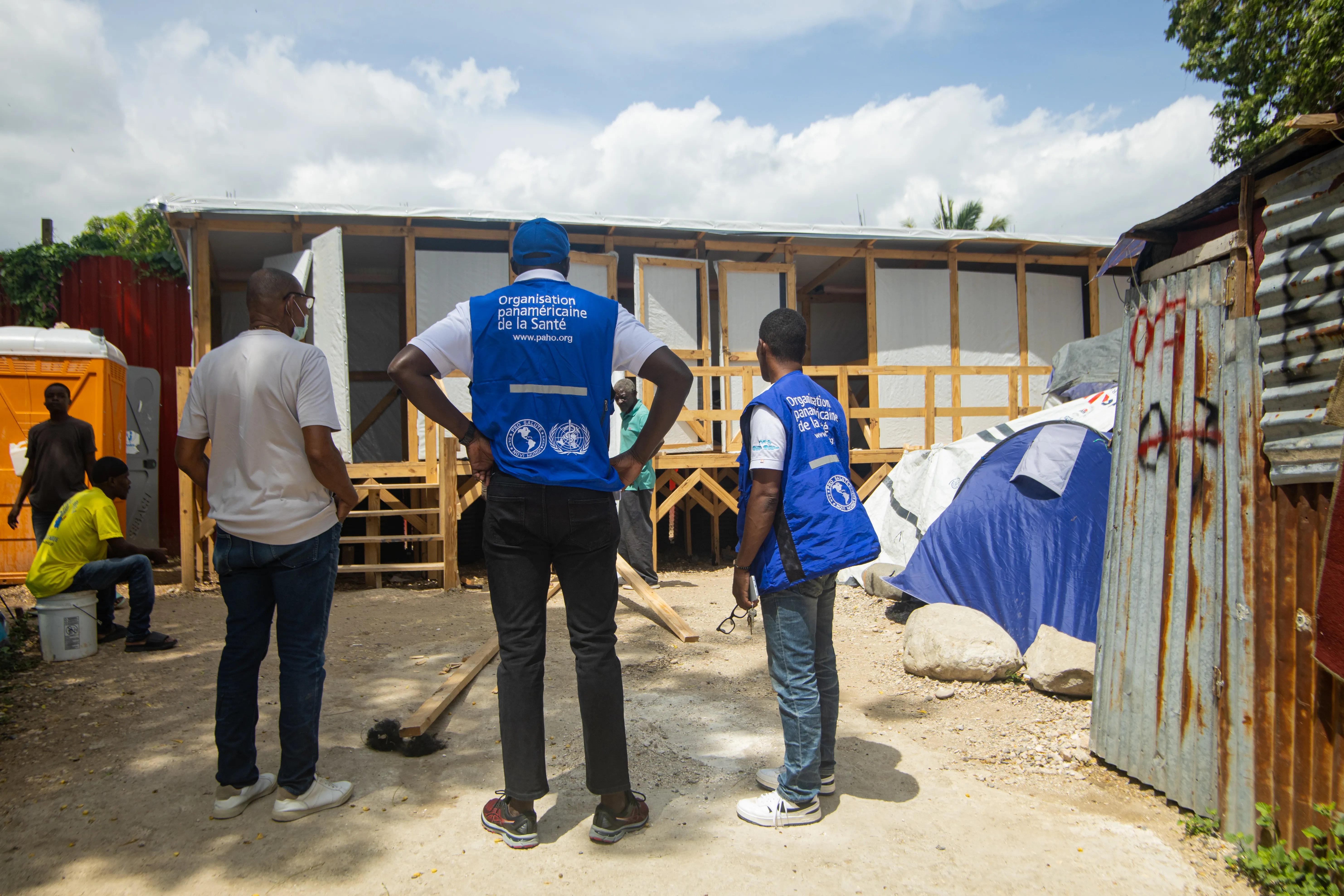
During the 2024–2025 biennium, PAHO played a critical role in sustaining essential blood transfusion services in Haiti in the face of persistent insecurity, prolonged electricity outages, and severe operational disruptions. These conditions posed a direct threat to the continuity, safety, and reliability of the national blood supply.
During the 2024–2025 biennium, PAHO provided technical cooperation to strengthen the resilience, quality, and continuity of emergency and obstetric care at the Hôpital Universitaire La Paix, the only major public referral hospital serving the metropolitan area of Port-au-Prince.
A landmark achievement during the biennium was Haiti’s formal adoption of the Maternal Death Surveillance and Response (MDSR) strategy as a national intervention, marking a decisive step toward reducing maternal mortality.
During the biennium, PAHO supported Haiti in establishing its first national coordination unit for noncommunicable diseases (NCD), injuries, and mental health, significantly strengthening national leadership and governance in this priority area.
During the 2024-2025 biennium, PAHO strengthened Haiti’s capacity to detect and respond to public health threats among internally displaced populations in the Artibonite and Centre departments, areas severely affected by insecurity and partial gang control.
| Outcome Indicator | Baseline/Target | Rating |
|---|---|---|
| 01.b. Number of countries and territories that have implemented strategies to strengthen the response capacity of the first level of care | Target 2025 | Partially achieved |
| 09.a. Number of countries and territories that have achieved, by 2025, a reduction of at least 10 percentage points in the population reporting access barriers to health services, as compared to 2020 | Target 2025 | Not achieved |
| 11.a. Number of countries and territories that have decreased by 20% the percentage of population in households experiencing out-of-pocket catastrophic health spending | Target 2025 | Not achieved |
| 11.b. Number of countries and territories that have decreased by 10% the percentage of people in households experiencing impoverishment due to out-of-pocket health expenditure | Target 2025 | Not achieved |
| Outcome Indicator | Baseline/Target | Rating |
|---|---|---|
| 04.c. Number of countries and territories with at least 95% coverage of syphilis treatment in pregnant women | Target 2025 | Achieved |
| 12.c. Number of countries and territories with increased antimicrobial resistance (AMR) surveillance capacity to guide the public health interventions for decreasing the risk and preventing the spread of multidrug-resistant infections through intersectoral action | Target 2025 | Partially achieved |
| 12.d. Number of countries and territories that have adequate mechanisms in place to prevent or mitigate risks to food safety | Target 2025 | Not achieved |
| 17.a. Number of countries and territories that achieve 90% of viral suppression (viral load <1,000 copies/ml) in persons on antiretroviral therapy (ART) | Target 2025 | Partially achieved |
| 17.c [c]. Interruption of transmission of neglected infectious diseases (NID) in countries, following WHO criteria and guidelines [Dog-mediated human rabies] | Target 2025 | Not achieved |
| 17.d. Number of countries and territories with established capacity and effective processes to eliminate human rabies transmitted by dogs | Target 2025 | Not achieved |
| Outcome Indicator | Baseline/Target | Rating |
|---|---|---|
| 05.e. Number of countries and territories whose surveillance systems have the capacity to report on key indicators of the Global Monitoring Framework for Noncommunicable Diseases | Target 2025 | Not achieved |
| 15.b. Number of countries and territories that have a national or multisectoral plan addressing violence that includes the health system | Baseline 2019 | Achieved |
| Outcome Indicator | Baseline/Target | Rating |
|---|---|---|
| 21.b. Number of countries and territories that generate, analyze, and use data and information according to health priorities, disaggregated by geopolitical and demographic strata, as appropriate to the national context | Target 2025 | Partially achieved |
| 21.c. Number of countries and territories with established mechanisms on knowledge management, multilingualism, open access, and publishing | Target 2025 | Not achieved |
| 22.a. Number of countries and territories implementing a funded policy, strategy and/or agenda on research and innovation for health | Target 2025 | Partially achieved |
| Outcome Indicator | Baseline/Target | Rating |
|---|---|---|
| 23.a. Number of countries and territories that meet or exceed minimum capacities to manage public health risks associated with emergencies | Target 2025 | Partially achieved |
| 23.b. Number of States Parties meeting and sustaining International Health Regulations (IHR) requirements for core capacities | Target 2025 | Achieved |
| 24.a. Number of countries and territories with installed capacity to effectively respond to major epidemics and pandemics | Target 2025 | Discrepancy |
| Outcome Indicator | Baseline/Target | Rating |
|---|---|---|
| 27.a. Proportion of countries and territories where the national health authority reports satisfaction with PAHO/WHO’s leading role on global and regional health issues | Target 2025 | Achieved |
| 27.b. Number of countries and territories for which there is alignment between the national health policy, strategy, or plan and the outcomes defined in the PAHO Strategic Plan 2020-2025 | Target 2025 | Achieved |
1. Access to comprehensive and quality health services
4. Response capacity for communicable diseases
5. Access to services for NCDs and mental health conditions
9. Strengthened stewardship and governance
11. Strengthened financial protection
12. Risk factors for communicable diseases
15. Intersectoral response to violence and injuries
17. Elimination of communicable diseases
21. Data, information, knowledge, and evidence
22. Research, ethics, and innovation for health
23. Health emergencies preparedness and risk reduction
24. Epidemic and pandemic prevention and control
27. Leadership and governance
| Output (OPT) Indicator | Baseline/Target | Rating |
|---|---|---|
| 01.2.a. Number of countries and territories implementing strategies and/or plans of action to improve quality of care in health service delivery | Target 2025 | Achieved |
| 02.2.e. Number of countries and territories implementing strategies to increase access to responsive and quality health services for adolescents | Target 2025 | Partially achieved |
| 07.3.a. Number of countries and territories enabled to strengthen health workforce competencies and capacity-building programs through the Virtual Campus for Public Health and other WHO platforms | Target 2025 | Achieved |
| 08.2.a. Number of countries and territories that have established an institutional development plan to improve regulatory capacity for health products based on the assessment of their national regulatory capacities by the Global Benchmarking Tool | Target 2025 | Not achieved |
| 09.2.a. Number of countries and territories with mechanisms for monitoring and evaluating progress toward universal health and primary health care using PAHO’s frameworks and tools | Target 2025 | Achieved |
| Output (OPT) Indicator | Baseline/Target | Rating |
|---|---|---|
| 04.1.a. Number of countries and territories implementing national norms, standards, and tools aligned with PAHO and WHO guidelines on TB, HIV, STIs, and VH, with emphasis on key and vulnerable populations | Target 2025 | Partially achieved |
| 04.3.a. Number of NID-endemic countries and territories that implement PAHO recommendations on integrated interventions to reduce the burden of NIDs through their health systems | Target 2025 | Not achieved |
| 04.4.a. Number of countries and territories that implement PAHO/WHO recommended policies and inter programmatic approaches related to malaria | Target 2025 | Achieved |
| 04.5.a. Number of countries and territories with DPT3 immunization coverage of at least 95% that are implementing strategies to reach unvaccinated and under-vaccinated populations | Target 2025 | Not achieved |
| 04.5.b. Number of countries and territories generating evidence to support decisions on the introduction or post-introduction of new vaccines | Target 2025 | Achieved |
| 12.4.a. Number of countries and territories that annually provide laboratory-based data on antimicrobial resistance | Target 2025 | Achieved |
| 12.5.a. Number of countries and territories reporting participation of communities in the response to HIV, TB, STIs, and viral hepatitis | Target 2025 | Achieved |
| 12.8.a. Number of countries and territories that have programs to prevent or mitigate zoonotic diseases and snake/arthropod envenoming | Target 2025 | Partially achieved |
| 17.1.a. Number of countries and territories implementing PAHO/WHO-recommended interventions in active foci and areas at risk of reestablishment of malaria | Target 2025 | Partially achieved |
| 17.5.a. Number of countries and territories that have maintained their status as free from both wild poliovirus and circulating vaccine-derived poliovirus | Target 2025 | Achieved |
| 17.8.a. Number of countries and territories implementing plans of action to strengthen prevention, prophylaxis, surveillance, and control for the validation of the elimination of rabies transmitted by dogs | Target 2025 | Not achieved |
| Output (OPT) Indicator | Baseline/Target | Rating |
|---|---|---|
| 05.1.a. Number of countries and territories that are implementing evidence-based national guidelines/protocols/standards for the management of NCDs (i.e. cardiovascular disease, cancer, diabetes, and chronic respiratory disease) | Target 2025 | Partially achieved |
| 14.1.a. Number of countries and territories that are implementing national policies consistent with the WHO Global Targets 2025 for maternal, infant, and young child nutrition and the nutrition components of the Sustainable Development Goals | Baseline 2023 | Achieved |
| 15.2.a. Number of countries and territories that have a national multisectoral coalition/task force to prevent and respond to violence that includes the health sector | Baseline 2023 | Not achieved |
| Output (OPT) Indicator | Baseline/Target | Rating |
|---|---|---|
| 18.2.f. Number of countries and territories implementing plans, policies, programs, and/or interventions to reduce health risks associated with household air pollution due to use of solid fuels for cooking and heating, following WHO guidelines | Target 2025 | Partially achieved |
| 26.2.a. Number of countries and territories implementing policies, plans, and strategies to advance health equity | Target 2025 | Not achieved |
| 26.3.a. Number of countries and territories implementing policies, plans, and programs to advance gender equality in health | Target 2025 | Not achieved |
| 26.5.a. Number of countries and territories using human rights norms and standards in the formulation and implementation of health-related policies, plans, programs, and legislation | Target 2025 | Partially achieved |
| Output (OPT) Indicator | Baseline/Target | Rating |
|---|---|---|
| 20.1.a. Number of countries and territories that have developed and implemented a plan to strengthen information systems for health based on PAHO’s IS4H maturity assessment model | Target 2025 | Partially achieved |
| 22.1.a. Number of countries and territories with a defined policy framework for research for health, including appropriate funding mechanisms reported to the WHO Global Observatory on Health Research and Development | Target 2025 | Partially achieved |
| Output (OPT) Indicator | Baseline/Target | Rating |
|---|---|---|
| 23.1.a. Number of States Parties completing annual reporting on the International Health Regulations (2005) | Baseline 2023 | Achieved |
| 23.2.a. Number of States Parties with national action plans developed for strengthening International Health Regulations (2005) core capacities | Target 2025 | Not achieved |
| 23.2.b. Number of countries and territories with full-time staff assigned to health emergencies | Baseline 2023 | Achieved |
| 23.3.a. Number of States Parties that have conducted simulation exercises or after-action review | Target 2025 | Not achieved |
| 23.4.a. Number of countries and territories that include safe hospital criteria in the planning, design, construction, and operation of health services | Baseline 2023 | Partially achieved |
| 23.5.a. Number of countries and territories that include criteria for disaster mitigation and climate change adaptation in the planning, design, construction, and operation of health services | Baseline 2023 | Partially achieved |
| 24.2.a. Number of countries and territories with strategies and/or plans in place to detect and respond to high-threat and emerging pathogens, including emerging zoonotic pathogens | Baseline 2023 | Partially achieved |
| 24.3.c. Number of countries and territories with operational integrated surveillance systems and pandemic preparedness plans for respiratory viruses, including influenza and COVID-19 | Baseline 2023 | Achieved |
| Output (OPT) Indicator | Baseline/Target | Rating |
|---|---|---|
| 27.1.a. Number of countries and territories with a current Country Cooperation Strategy | Target 2025 | Achieved |