* Since the last assessment in 2024, updated information became available that required a change in the baseline and target.
EOB 2024-2025
IMPACT INDICATOR

Mortality rate attributed to household and ambient air pollution
Baseline
2019
32.29 deaths per 100 000 population*
Target
2025
30.7 deaths per 100 000 population*
Status
2023
29.92 deaths per 100 000 population
Rating
Achieved
% annual change required to achieve target
-0.85%
% annual change recorded as of last year available
-1.91%
This indicator measures progress toward reducing the number of avoidable deaths attributed to air pollution in the Americas. It is a composite indicator, measuring deaths attributed to the use of polluting household fuels for cooking and exposure to ambient air pollution.
Based on updated regional estimates, the mortality rate from household and ambient air pollution in the Region declined from a baseline of 32.3 deaths per 100 000 population in 2019 to 29.9 in 2023, representing a 7.4% reduction over the period. The average annual reduction of 1.9% suggests a rate of decline broadly consistent with that required to meet the target of 30.7 deaths per 100 000 population. The projected rate for 2025 is 28.1 deaths per 100 000 population. Therefore, this indicator has been achieved.
This favorable trend is consistent with ongoing reductions in exposure to pollution in households. During the period analyzed, nearly 4 million people gained access to clean household energy sources. Alongside broader efforts to improve air quality, PM2.5 concentrations in the Region have shown a consistent decline.
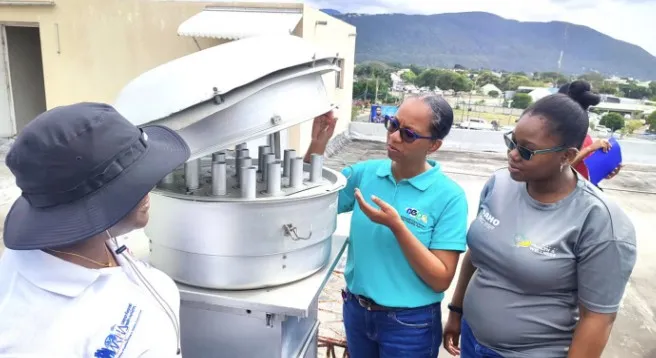
Supported by PAHO’s technical cooperation, Brazil, Chile, and Panama adopted air quality rules based on WHO Air Quality Guidelines. The Dominican Republic and Guatemala established new air quality monitoring networks, and several countries expanded their surveillance capacities. Action is also needed at the subnational level, including in cities. Barranquilla is developing infrastructure that reduces air pollution, encourages physical activity, and mitigates environmental challenges, including climate change. The Bureau has partnered with cities and Member States to estimate the health gains of such interventions using a global health impact assessments tool.
The Region hosts the first regional expert group of AirQ+, establishing a critical mass of expertise to support the use of health impact assessment tools in decision-making processes. Through PAHO’s Disease Elimination Initiative, Colombia, El Salvador, and Peru are advancing efforts to eliminate the use of polluting fuels for cooking, using the global Benefits of Action to Reduce Household Air Pollution (BAR-HAP) tool to estimate health gains.
Despite this progress, important bottlenecks remain and will need to be addressed as this indicator continues to be monitored under the PAHO Strategic Plan 2026–2031. Air pollution remains a major environmental risk to health in the Americas and continues to disproportionately affect populations in situations of vulnerability. Continued exposure to ambient air pollution in urban settings, persistent household use of polluting fuels in some populations, and limitations in air quality monitoring and in the timeliness and disaggregation of health and exposure data constrain more precise targeting of interventions and the monitoring of disparities.
Recommendations
Sustain and accelerate the transition to clean household energy, particularly among underserved populations and those in situations of vulnerability, through the implementation of initiatives aimed at eliminating polluting fuels for cooking and heating, in line with the Disease Elimination Initiative.
Implement PAHO’s Regional Roadmap on Air Quality and Health to advance regional action to reduce the burden of disease attributable to air pollution, including by integrating actions on air pollution with efforts to address risk factors for noncommunicable diseases.
Strengthen national and subnational air quality policies and standards in line with the 2021 global Air Quality Guidelines, with stronger integration of health considerations into environmental, urban, transport, and energy policies.
Increase investment in air quality monitoring and health surveillance systems to improve the completeness, timeliness, and disaggregation of exposure and mortality data, thereby enabling more robust analysis and more precise targeting of interventions.
Expand technical cooperation and intersectoral action to scale up the use of health impact assessment tools, strengthen institutional capacity, and translate evidence into effective action to further reduce mortality attributable to household and ambient air pollution.